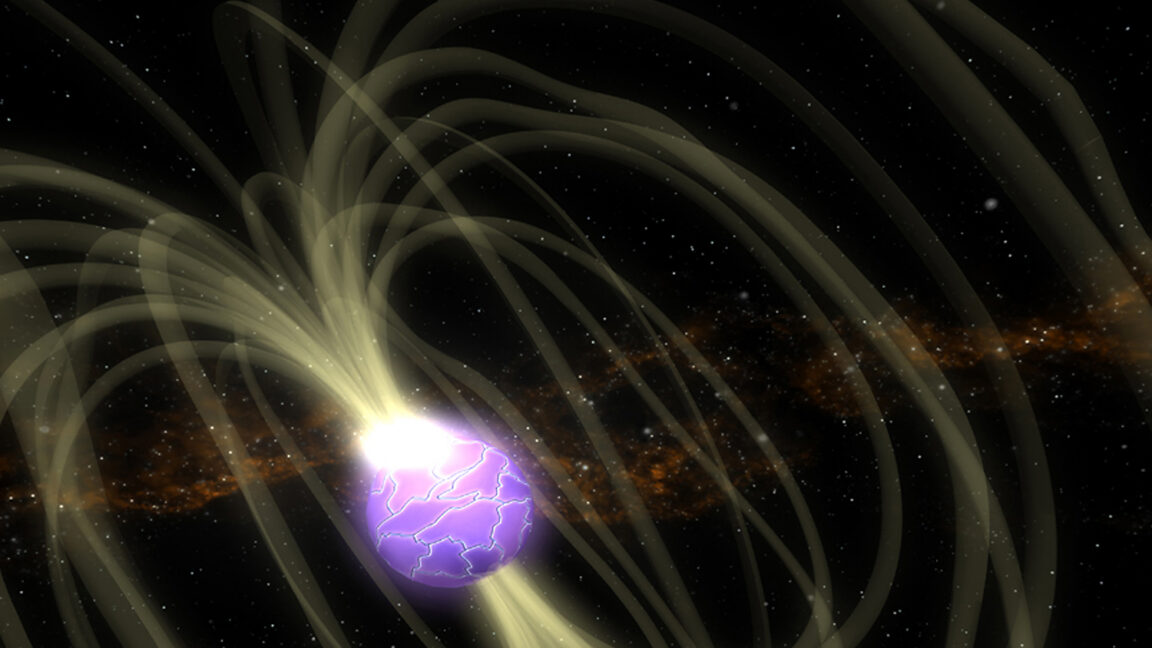
Superluminous supernovae are among the universe's brightest explosions, and magnetars—rapidly spinning neutron stars with extreme magnetic fields—are likely their power source. These magnetars form from collapsing stellar cores and transfer rotational energy to expanding debris, causing the supernova to brighten. However, standard magnetar models predicted smooth light curves that fade evenly, contradicting observations showing irregular flickering and modulations over months. Frame-dragging, a relativistic effect where spinning objects warp spacetime around them, provides a mechanism to explain these observed irregularities in the light patterns.
"Magnetars have been a leading candidate for the engine behind superluminous supernovae. The theory says these insanely magnetized stars are born from the collapsing core of the original progenitor star and emit energy via magnetic dipole radiation. This core is roughly a one solar mass object that gets crushed down to the size of a city. As its spin slows down, a magnetar bleeds its rotational energy into the expanding material of the dead star, lighting it up."
"In a standard magnetar model, the light curve of the supernova should rise rapidly and then fade away evenly as the neutron star loses its rotational energy. But when astronomers observe superluminous supernovae, they almost never see this smooth fade. Instead, they see bumps, wiggles, and strange modulations. The light curve flickers over months."
Read at Ars Technica
Unable to calculate read time
Collection
[
|
...
]