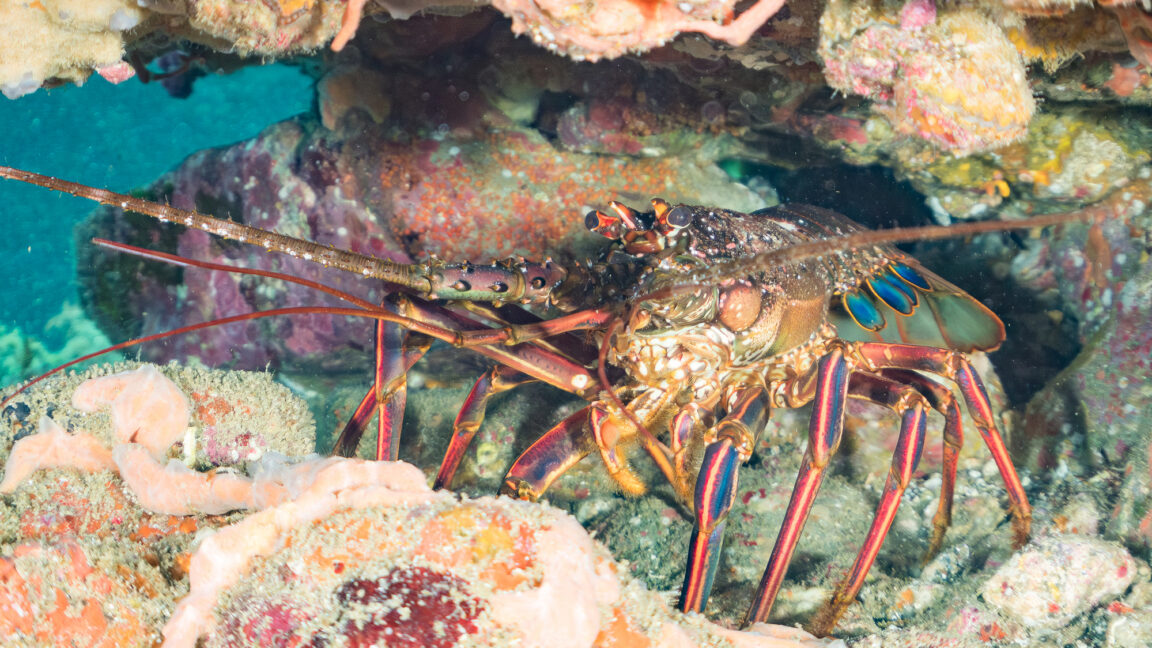
Solution holes with resident groupers contain older lobsters whose chemical emissions attract younger lobsters seeking shelter. Equivalent sites lacking groupers were compared by daily underwater surveys, with lobster size recorded and new individuals tagged to follow population changes and migration. Predation was measured by tethering lobsters to limit site departure and by examining grouper stomach contents, which in some cases contained previously tagged lobsters. Sites with groupers showed average lobster sizes 32% larger and over two-thirds mortality of small tethered lobsters within 48 hours, versus about 40% mortality at control sites.
"The older lobsters that find shelter in a solution hole would emit the chemicals that draw younger ones to congregate with them. But the youngsters would then fall prey to any groupers that inhabit the same solution hole. In other words, what is normally a cue for safety-the signal that there are lots of lobsters present-could lure smaller lobsters into what the authors call a "predatory death trap.""
"To check predation, they linked lobsters (both large and small) via tethers that let them occupy sheltered places on the sea floor, but not leave a given site. And, after the lobster population dynamics were sorted, the researchers caught some of the groupers and checked their stomach contents. In a few cases, this revealed the presence of lobsters that had been previously tagged, allowing them to directly associate predation with the size of the lobster."
Read at Ars Technica
Unable to calculate read time
Collection
[
|
...
]