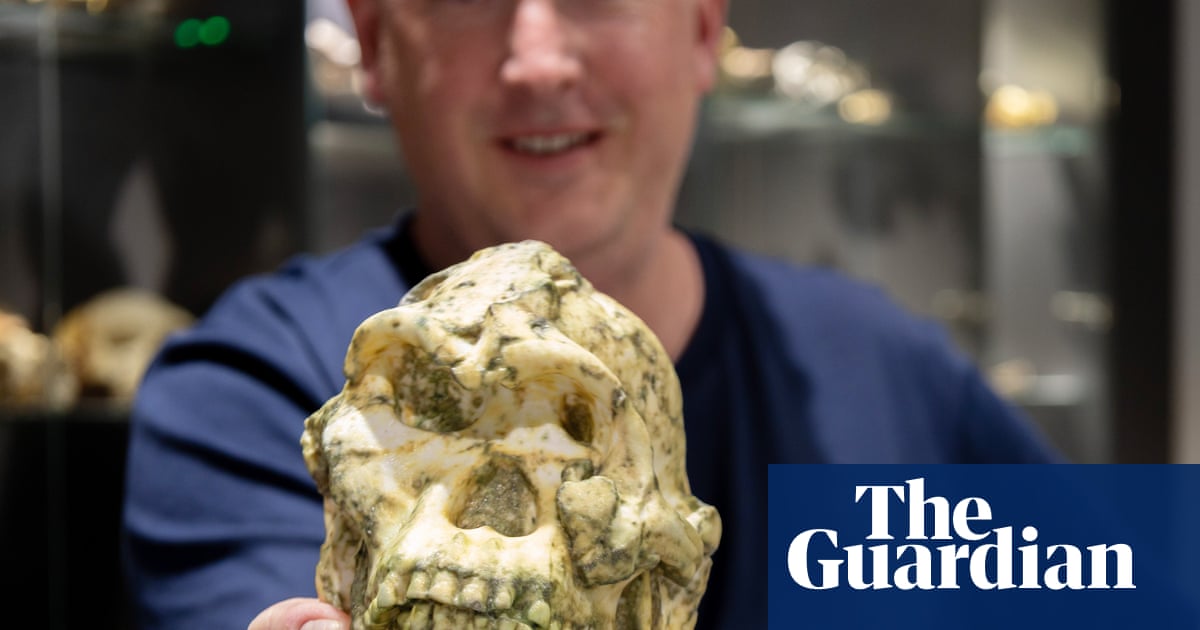
"Little Foot, one of the world's most complete hominin fossils, may be a new species of human ancestor, according to research that raises questions about our evolutionary past. Publicly unveiled in 2017, Little Foot is the most complete Australopithecus skeleton ever found. The foot bones that lend the fossil its name were first discovered in South Africa 1994, leading to a painstaking excavation over 20 years in the Sterkfontein cave system."
"Prof Ronald Clarke, a paleoanthropologist at the University of the Witwatersrand, who led the team that excavated the skeleton, attributed Little Foot to the species Australopithecus prometheus. Others believed it was Australopithecus africanus, a species first described in 1925 and which had previously been found in the same cave system. Australopithecus meaning southern ape was a group of hominins that existed in Africa as early as 4.2m years ago."
"It doesn't look like Australopithecus prometheus but it also doesn't look like all of the africanus to come out of Sterkfontein. Martin, also a postdoctoral research fellow at the University of Cambridge, added: This thing will be part of a lineage of hominins, so it's possible that we have not just a point in our human family tree that we hadn't discovered before, but an entire limb of that tree."
Little Foot is the most complete Australopithecus skeleton, with foot bones discovered in 1994 and a 20-year excavation in the Sterkfontein cave system, publicly unveiled in 2017. The specimen has been variously attributed to Australopithecus prometheus and to Australopithecus africanus, a species first described in 1925 and previously found at Sterkfontein. Morphological traits of Little Foot differ from both named species. Those differing traits indicate a possible formerly unknown, unsampled hominin species and raise the possibility of an entire distinct lineage of hominins present at Sterkfontein. Sterkfontein yields Australopithecus fossils dating as early as 4.2 million years ago.
Read at www.theguardian.com
Unable to calculate read time
Collection
[
|
...
]