"Analogue quantum simulations are a useful tool for investigating these systems, particularly in regimes in which the applicability of numerical techniques is limited. For different simulator platforms, figures of merit include the electron bandwidth and interaction strength, temperature and the number of simulated lattice sites. Their use is further underscored by the ability to realize distinct lattice geometries, on-site degrees of freedom and by the physical observables that are accessible to experimental measurement."
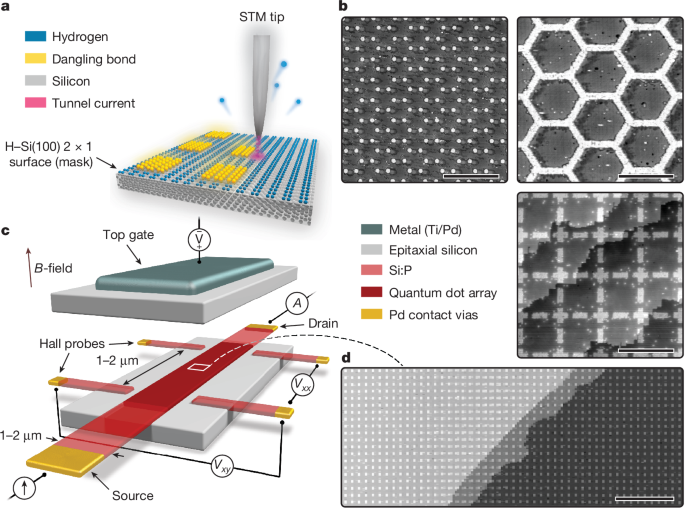
"Recent works on topological states in 1D chains and Fermi-Hubbard physics in small 2D arrays have shown that atom-based quantum dots, precision-manufactured using scanning tunnelling microscope (STM) lithography (Supplementary Information Section S1A), have many unique qualities advantageous to analogue quantum simulation. The strong Coulomb potential of the donor nuclei naturally creates strong local and long-range interactions that play a key role in many complex phenomena in quantum materials and chemistry"
Strongly correlated quantum states appear in systems with complex band topology and strong interactions and are central to quantum materials and chemistry. Analogue quantum simulations enable exploration of regimes where numerical techniques fail, with key figures of merit including electron bandwidth, interaction strength, temperature, and lattice site count. Atom-based quantum dots fabricated by STM lithography provide strong local and long-range Coulomb interactions and allow arbitrary lattice and dot geometries. These dots avoid confinement electrodes, simplifying scaling to large arrays and offering simulation capabilities beyond gate-defined dots, ultracold atoms, and van der Waals materials. Scaled demonstrations remain to be achieved.
Read at Nature
Unable to calculate read time
Collection
[
|
...
]