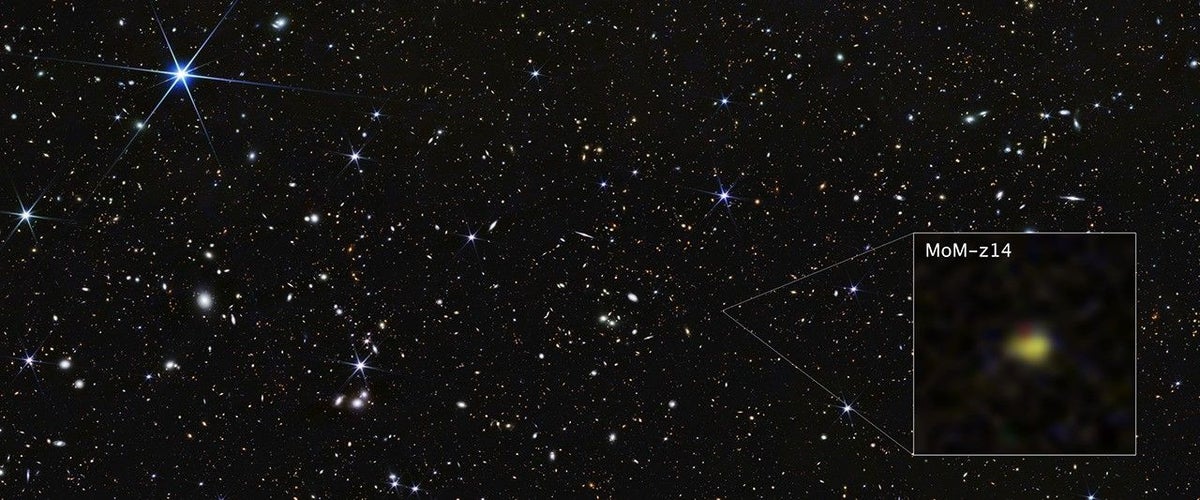
MoM-z14 is a bright galaxy detected with NASA's James Webb Space Telescope that existed about 280 million years after the Big Bang. Its light has taken more than 13 billion years to reach Earth and corresponds to a record high redshift near 14.4. The galaxy appears brighter, denser, and more chemically rich than models predicted for that epoch, posing challenges to current views of early galaxy formation. Redshift measures the stretching of light as the universe expands and is used to determine such distances. Webb's sensitivity enables detection of evolved, luminous systems at very high redshift, prompting reevaluation of early star formation and enrichment timelines.
"With Webb, we are able to see farther than humans ever have before, and it looks nothing like what we predicted, which is both challenging and exciting, said Rohan Naidu, an astronomer at the Massachusetts Institute of Technology and the lead author of a preprint paper detailing MoM-z14's discovery that will soon be published in the overlay journal Open Journal of Astrophysics, in a statement in NASA's announcement."
"To pinpoint galaxies like MoM-z14, astronomers use redshift. Essentially, this is the measure of how stretched the light coming from an object is as a result of that object moving away from our perspective as the universe expands. The higher the redshift, the farther the object is. In MoM-z14's case, it has a redshift of 14.4a record, Scientific American columnist Phil Plait noted late last year."
Read at www.scientificamerican.com
Unable to calculate read time
Collection
[
|
...
]