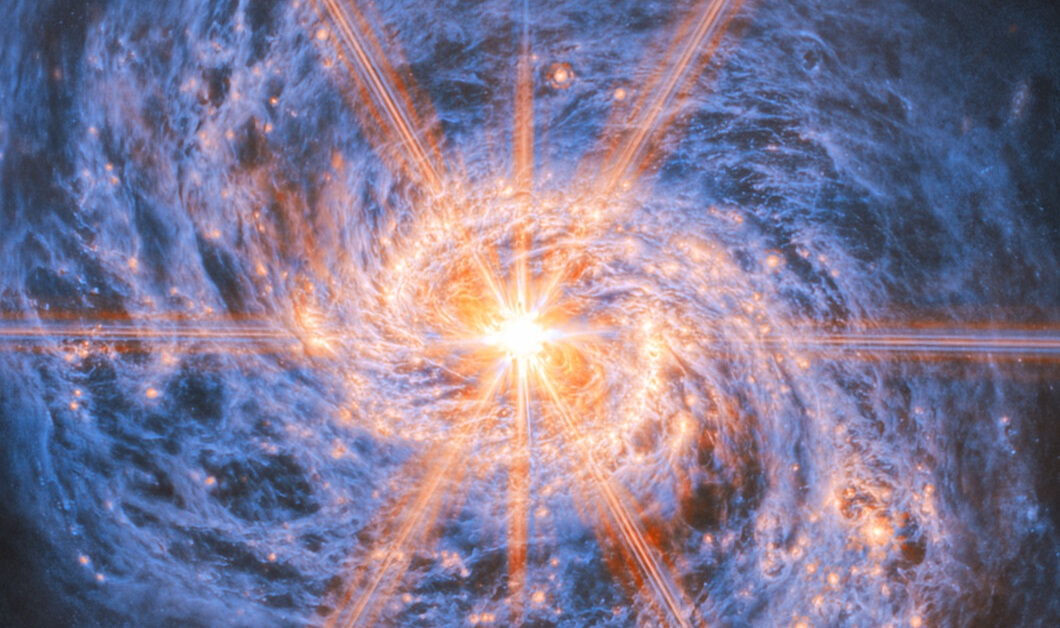
"At eight million times the mass of the Sun, the black hole is pulling matter towards itself, which begins to swirl around it like water circling a drain, and heating up in the process. That heat is so intense, and the amount of matter captured so enormous, that the light the black hole's so-called accretion disk produces outshines the entire surrounding galaxy."
"The new image, taken with Webb's Mid-Infrared Instrument, also reveals something invisible in optical wavelengths: the Squid Galaxy's central bar. This is a distinctly straight region, packed with stars, that bisects the outer spiral arms. The Squid Galaxy's bar is surrounded by a bright band called a starburst ring, where star formation is off the charts."
"Like our own Milky Way, it takes the form of a barred spiral galaxy, but its center is far more luminous. That's because it's dominated by an active galactic nucleus, a term that describes a supermassive black hole in the midst of a voracious feeding frenzy."
"By contrast, our milky way's supermassive black hole, Sagittarius A*, is nowhere near as attention-grabbing. While it's also surrounded by an accretion disk, it isn't devouring enough matter to be considered an active galactic nucleus."
Messier 77, also called the Squid Galaxy, is a barred spiral galaxy about 45 million light-years away in Cetus. Its center is far more luminous than its surroundings because an active galactic nucleus dominates the region. A supermassive black hole about eight million solar masses pulls in matter, forming an accretion disk that heats up and produces light that outshines the entire galaxy. In contrast, Sagittarius A* in the Milky Way is not feeding enough matter to be classified as an active galactic nucleus. Mid-infrared observations with Webb’s MIRI reveal an optically invisible central bar and a surrounding starburst ring where star formation is intense. Gas abundance fuels both black hole feeding and star formation.
Read at Futurism
Unable to calculate read time
Collection
[
|
...
]