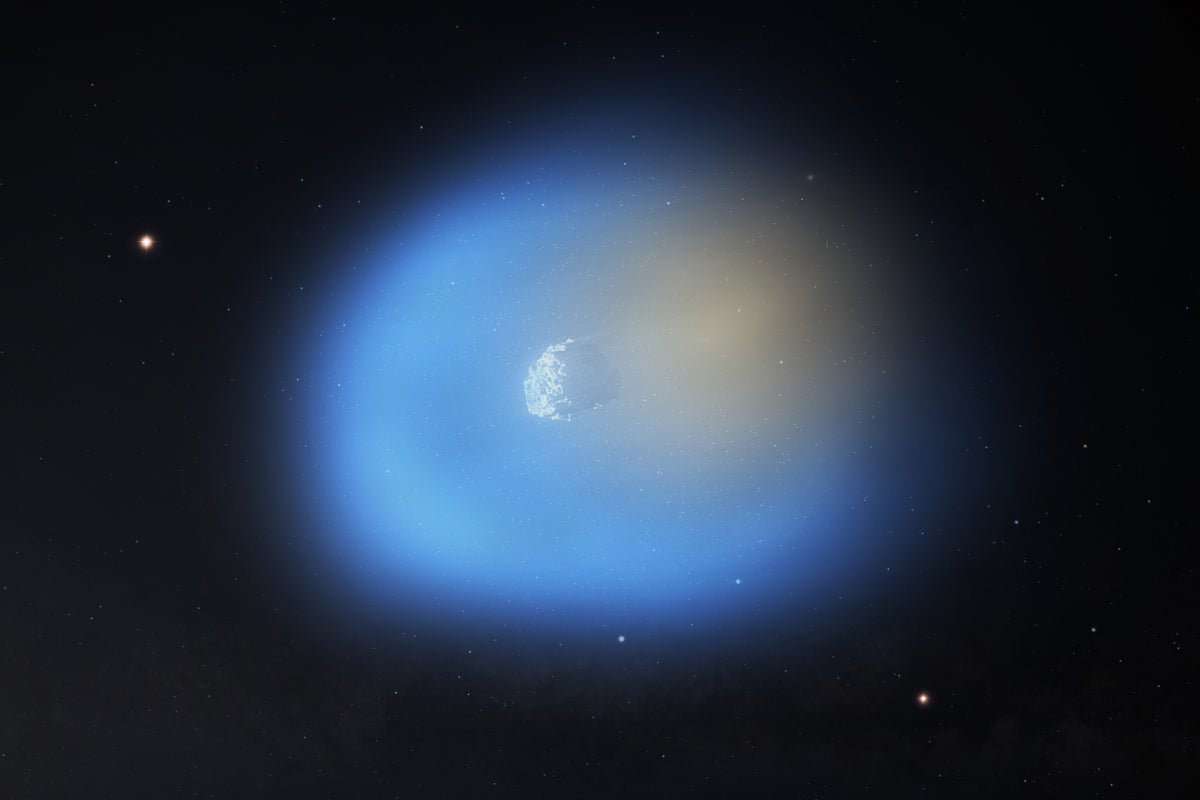
"Observing 3I/ATLAS is like taking a fingerprint from another solar system, said Nathan Roth, a research assistant professor at American University, in a statement. The details reveal what it's made of, and it's bursting with methanol in a way we just don't usually see in comets in our own solar system."
"When a typical comet nears the sun, ice inside the space rock turns to gas, leaving a trail of gases such as carbon monoxide, methane and ammonia in its wake—sometimes a little methanol. But according to new measurements from the ground-based Atacama Large Millimeter/submillimeter Array (ALMA) in Chile, the interstellar interloper is heavily enriched in methanol—indeed, far, far more methanol than astronomers would have expected."
Interstellar Comet 3I/ATLAS, only the third interstellar object ever discovered, passed near Earth's sun at speeds exceeding 150,000 miles per hour, enabling detailed scientific observation. Using the Atacama Large Millimeter/submillimeter Array (ALMA) in Chile, researchers detected unusually high concentrations of methanol in the comet. While typical comets release gases like carbon monoxide, methane, and ammonia as ice vaporizes near the sun, 3I/ATLAS is heavily enriched in methanol far beyond expected levels. This composition acts as a fingerprint from another solar system, revealing information about the comet's origin and the conditions in distant star systems beyond our cosmic neighborhood.
Read at www.scientificamerican.com
Unable to calculate read time
Collection
[
|
...
]