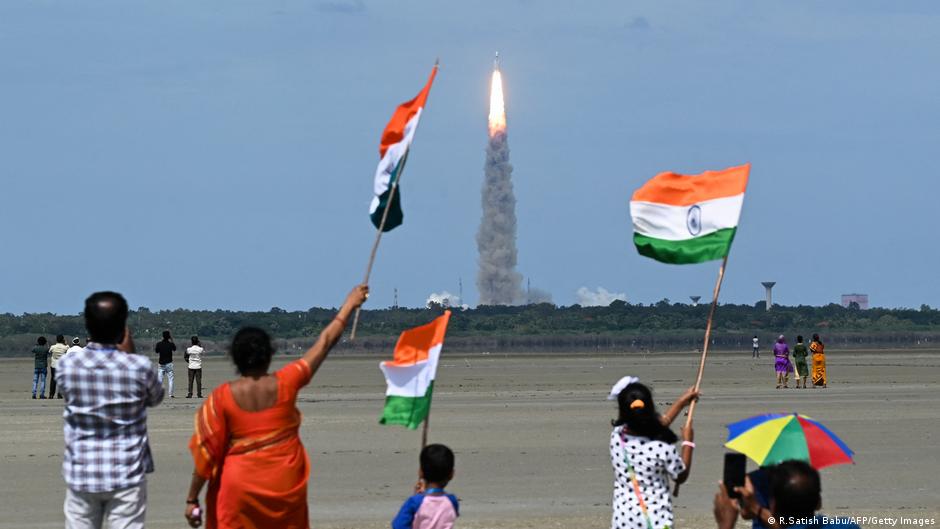
"India was due to send its own spacecraft, crewed with its own astronauts, into orbit in 2022. But COVID-19 and a series of technical setbacks have consistently delayed the Gaganyaan mission's progress. ISRO the Indian Space Research Organization has now certified its LMV3 launch rocket for human travel and is aiming to complete three uncrewed launches of the Gaganyaan spacecraft in 2026. If things go to plan, three astronauts (or "Gaganyatris") selected from air force pilots Prasanth Balakrishnan, Ajit Krishnan, Angad Pratap and Shubhanshui Shukla, will be strapped in for the maiden voyage. The earliest that launch could take place is 2027."
""The goal is really less scientific, more of a geopolitical one," Singh said. "It's just to make sure that India has a presence with the big players, and all of those big players have a human spaceflight program.""
"It became the fourth nation after the US, Soviet Union and China to safely land on the moon, when its Chandrayaan-3 mission touched down on the lunar surface in 2023. In doing so, it also became the first nation to send a spacecraft to the moon's South Pole, which is a difficult place to land. In 2014, it successfully sent its Mars Orbiter spacecraft to the Red Planet."
India's Gaganyaan human-spaceflight program has faced COVID-19 and technical delays, but ISRO has certified the LMV3 rocket and aims for three uncrewed Gaganyaan launches in 2026. Four air force pilots have been shortlisted for a three-person inaugural crew, with the earliest possible crewed launch in 2027. A successful crewed mission would place India among the few nations that have launched astronauts on sovereign spacecraft. ISRO's prior achievements include Chandrayaan-3's 2023 South Pole lunar landing and the 2014 Mars Orbiter. The program's emphasis blends geopolitical recognition with scientific capability.
Read at www.dw.com
Unable to calculate read time
Collection
[
|
...
]