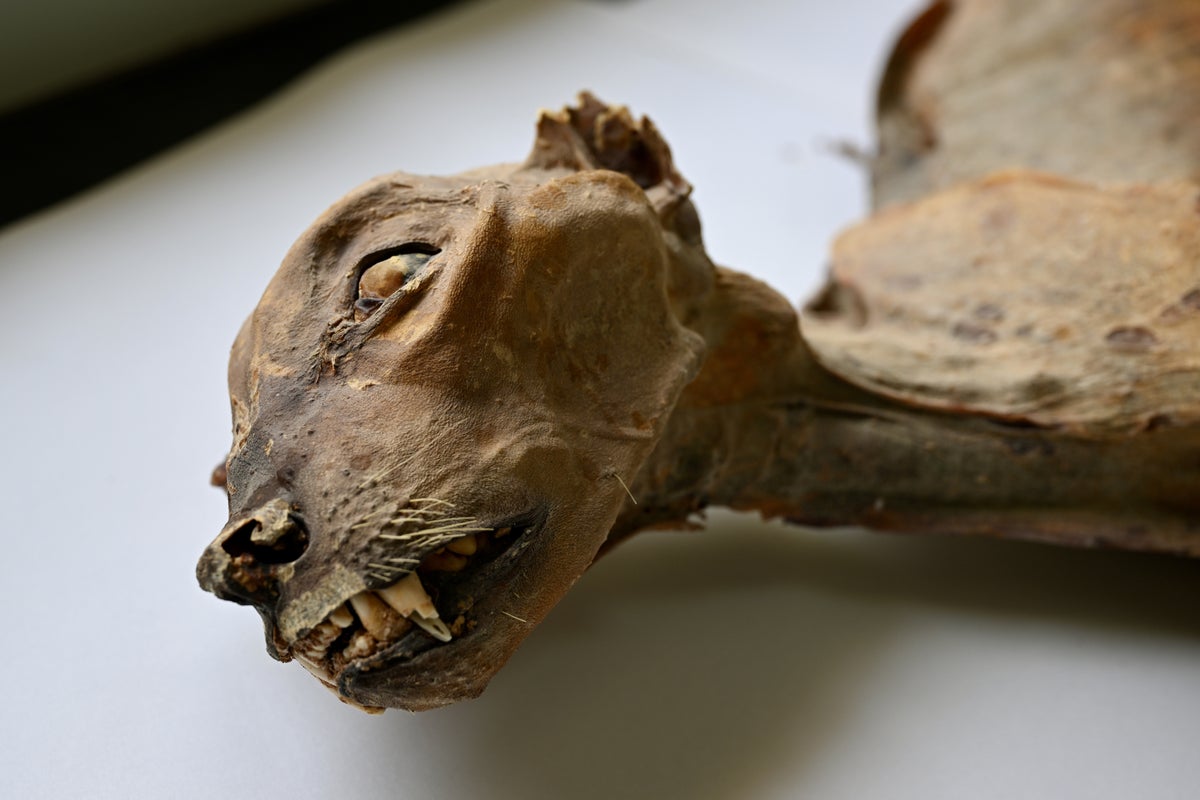
"Researchers have discovered the naturally mummified and skeletal remains of 61 cheetahs, which were hidden deep inside caves in northern Saudi Arabia for hundreds, and in some cases thousands, of years. The find indicates that these big cats roamed the Arabian Peninsula for millennia before they disappeared from the landscape between 49 and 188 years agoevidence that bolsters an effort to rewild the region with modern-day cheetahs, according to Ahmed Boug, general director of the National Center for Wildlife in Riyadh."
"Of the 61 cheetahs found, seven were naturally mummifieddried and preserved by the Saudi Arabian desert. Boug and his colleagues carbon dated two of these specimens and five of the skeletal remains, with the oldest having lived some 4,000 years ago and the youngest having lived about 130 years ago. They also sequenced the genomes of three of the seven sampled specimens."
"They also sequenced the genomes of three of the seven sampled specimens. The older cheetah remains were more genetically similar to a Northwest African subspecies, whereas the more recent cheetah remains were more similar to the Asiatic cheetah, which is now mostly confined to a very small population in Iran. It was a big surprise, Boug says."
The naturally mummified and skeletal remains of 61 cheetahs were found deep inside caves in northern Saudi Arabia, preserved for hundreds to thousands of years. Seven specimens were naturally mummified and several skeletal remains were recovered. Carbon dating produced ages ranging from about 4,000 years to roughly 130 years, while local disappearance dates span roughly 49 to 188 years ago. Genomes were sequenced for three specimens. Older remains matched Northwest African genetic lineages, whereas more recent remains resembled the Asiatic cheetah, now largely restricted to a tiny Iranian population. The evidence supports consideration of regional rewilding with modern cheetahs.
Read at www.scientificamerican.com
Unable to calculate read time
Collection
[
|
...
]