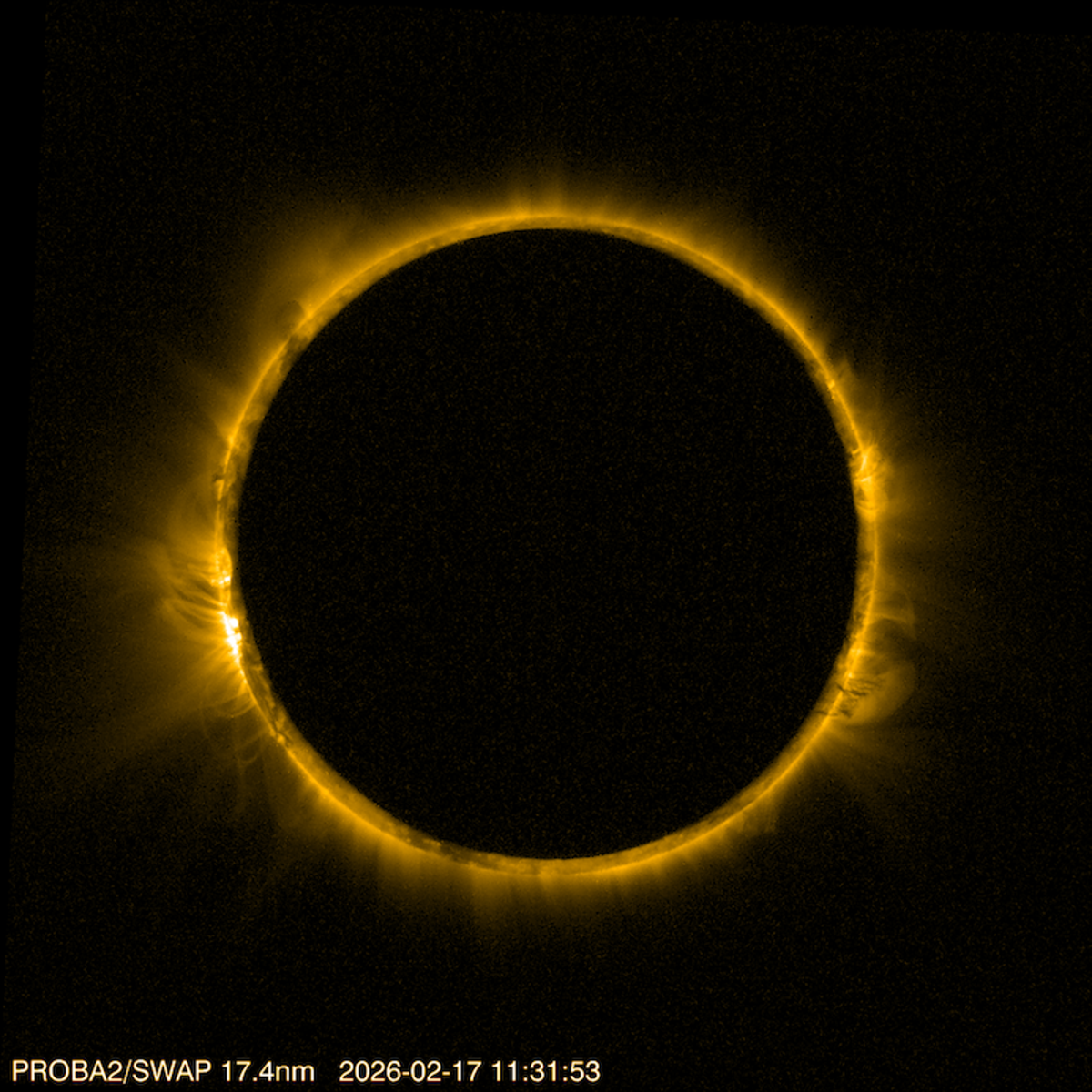
"Just days ago the moon traveled directly between Earth and the sun in what was the first solar eclipse of the year, producing a striking ring of fire effect in the sky. Unluckily for many sky-gazers, however, only those in Antarctica, or just off the coast of it, would have seen the full eclipse on February 17. But now new images from the European Space Agency (ESA) reveal the solar eclipse in all its plasmatic glory thanks to ESA's PROBA-2 satellite."
"PROBA-2 is a small satellite that hosts two primary instruments designed to observe the sun and other instruments to study space weather. As the craft orbited our planet, the satellite imaged the eclipse at least four times and captured a perfect ring of fire, according to the agency. Also known as an annular eclipse, the ring of fire effect is created because the moon appears slightly smaller than the sun in the sky."
The moon passed directly between Earth and the sun on February 17, producing an annular solar eclipse that created a visible ring of fire. The full ring was primarily visible from Antarctica and nearby offshore locations, with Concordia Station reportedly viewing the ring for about two minutes. ESA's PROBA-2 satellite imaged the eclipse at least four times, capturing detailed plasma-rich views. An annular eclipse occurs because the moon appears slightly smaller than the sun and cannot fully block sunlight, leaving a glowing halo. The next notable eclipse is a total lunar eclipse on March 3, 2026, a blood moon visible across many regions.
Read at www.scientificamerican.com
Unable to calculate read time
Collection
[
|
...
]