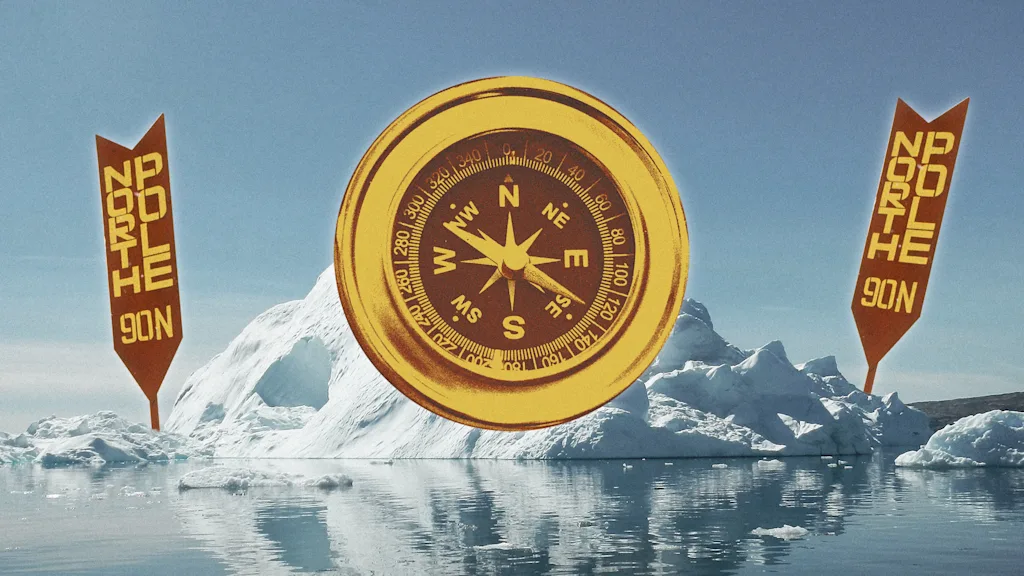
"When Santa Claus is done delivering presents on Christmas Eve, he must get back home to the North Pole, even if it's snowing so hard that the reindeer can't see the way. He could use a compass, but then he has a challenge: He has to be able to find the right North Pole. There are actually two North Poles -the geographic North Pole you see on maps and the magnetic North Pole that the compass relies on. They aren't the same."
"The geographic North Pole, also called true north, is the point at one end of the Earth's axis of rotation. Try taking a tennis ball in your right hand, putting your thumb on the bottom and your middle finger on the top, and rotating the ball with the fingers of your left hand. The place where the thumb and middle finger of your right hand contact the tennis ball as it spins define the axis of rotation. The axis extends from the south pole to the north pole as it passes through the center of the ball."
"Earth's magnetic North Pole is different. More than a thousand years ago, explorers began using compasses, typically made with a floating cork or piece of wood with a magnetized needle in it, to find their way. The Earth has a magnetic field that acts like a giant magnet, and the compass needle aligns with it."
Santa must return to the North Pole after delivering presents, and heavy snow can make navigation difficult. Compasses point toward the magnetic North Pole rather than the geographic North Pole. The geographic North Pole is the point at one end of Earth's axis of rotation and can be visualized using a rotating tennis ball to show the axis. The magnetic North Pole results from Earth's magnetic field, which causes compass needles to align. Early compasses used a floating cork or piece of wood with a magnetized needle. Navigators must distinguish between geographic and magnetic north to find the correct pole.
Read at Fast Company
Unable to calculate read time
Collection
[
|
...
]