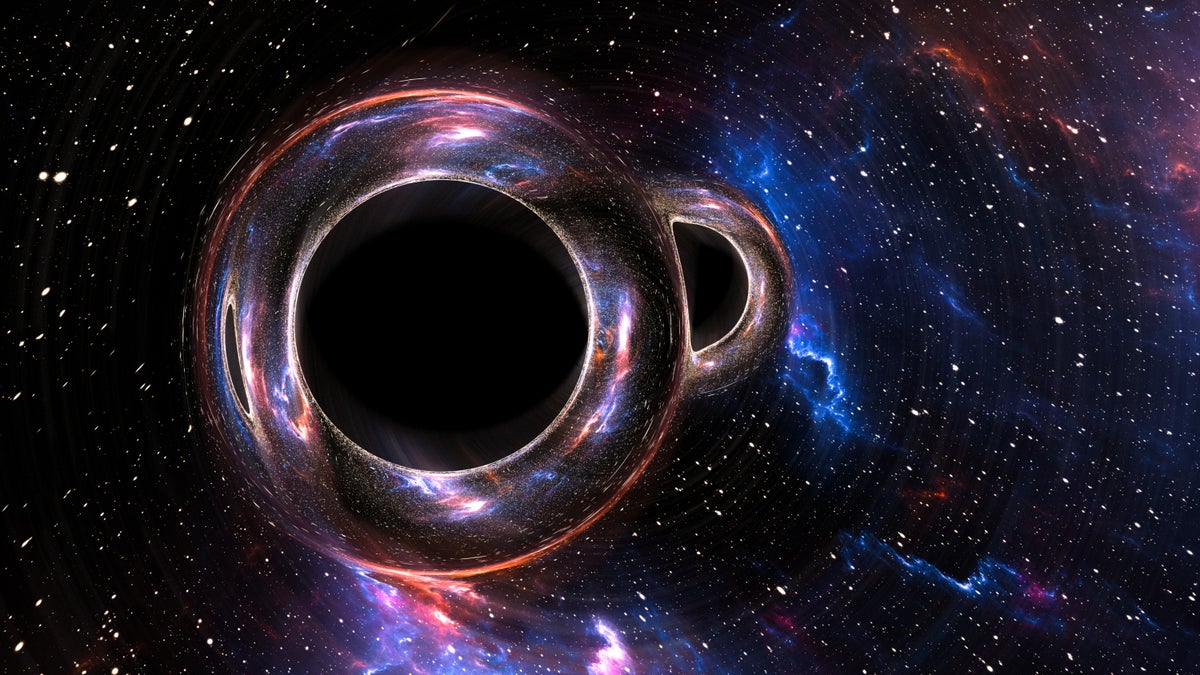
"They also make very big bangs indeed, with their collisions rapidly releasing almost incomprehensible amounts of energy. You might think it's obvious that merging is the final fate of two black holes. These objects' whole shtick, after all, is gobbling up stuff, so two of them trying to eat each other feels inevitable. What happens when they do, though, is not at all straightforward. Just the fact that they release energyso much energywhen they collide seems impossible."
"The stars eventually go supernova, and their respective cores collapse to form black holes containing as much as 100 times the mass of the sun. Such systems are relatively rare to begin with. But rarer still are those with paired black holes that are sufficiently close together to eventually collide. If such black holes were to form a billion kilometers from each other, a merger could take longer than the nearly 14-billion-year-old universe has existed."
Black hole collisions produce immense bursts of energy when binaries merge. Binary stellar-mass black holes typically originate from pairs of massive, mutually orbiting stars whose cores collapse into black holes after supernovae, sometimes reaching ~100 solar masses. Such paired black holes are rare, and only those formed sufficiently close can merge within a Hubble time; separations of about a billion kilometers can prevent merging for longer than the universe's age. The most intense physics occurs just outside the event horizons where infalling matter and spacetime dynamics generate gravitational waves and electromagnetic phenomena. Mergers therefore probe extreme gravity and energy release mechanisms.
Read at www.scientificamerican.com
Unable to calculate read time
Collection
[
|
...
]