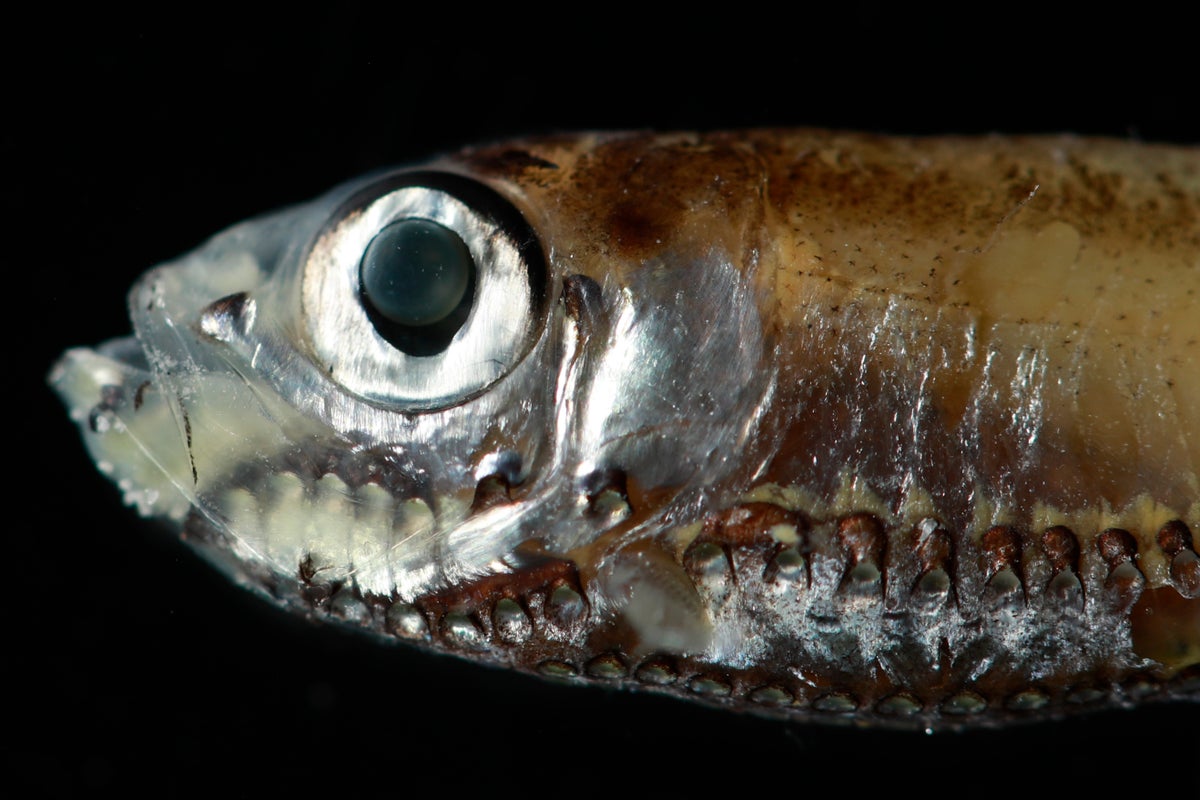
Larvae of hatchetfish, lanternfish and lightfish in the Red Sea possess retinal photoreceptor cells that combine structural and functional elements of both cones and rods. One hatchetfish species retains these hybrid photoreceptors into adulthood, while lanternfish and lightfish transition to rod-only retinas. Hybrid photoreceptors likely provide visual capabilities suited to twilight-zone lighting, balancing sensitivity to low light with aspects of cone functionality. Twilight-zone light conditions challenge pure rods and cones, making intermediate photoreceptor types advantageous for feeding, predator avoidance, and survival. Photoreceptor identity appears to span a spectrum rather than forming strictly separate categories.
"Some deep-sea fish may be able to see light in a different way from most other vertebrates, according to a new study. The fish, found in the Red Sea, have what the scientists behind the new study describe as hybrid photoreceptorslight-sensing cells in the retina that combine elements of two distinct kinds of photoreceptors, cones and rods. In human retinas, cone cells enable us to see in bright environments, detecting color and fine detail,"
"The ocean's twilight zone isn't an ideal environment for either rod or cone cells, explains Lily Fogg, a postdoctoral researcher at the University of Basel in Switzerland and the lead author of the study. Yet many deep-sea fish often start their lives there, which raised the question: How do these tiny larvae see well enough to feed, avoid predators, and survive in the murky midwater depths?"
Read at www.scientificamerican.com
Unable to calculate read time
Collection
[
|
...
]