"Okay, first thing first: the universe is in fact expanding. We've known this for more than a century now, and it's the basis for modern cosmology. This idea is called the big bang modelwhich is an unfortunate name because it brings to mind a cosmos expanding like an explosion, with galaxies moving away from each other through space like shrapnel. But in fact space itself is expanding, and that's different."
"I get e-mail. Most messages are press releases about astronomical discoveriesokay, scratch that; most of them are spam, but science announcements are an easy second place. But I also get questions from readers asking about various aspects of the universe that they're struggling to understand. I love this! For one thing, it shows that people really are curious about science, and you have to dig that. For another, it gives me a chance to explain counterintuitive concepts that are probably bugging other people as well."
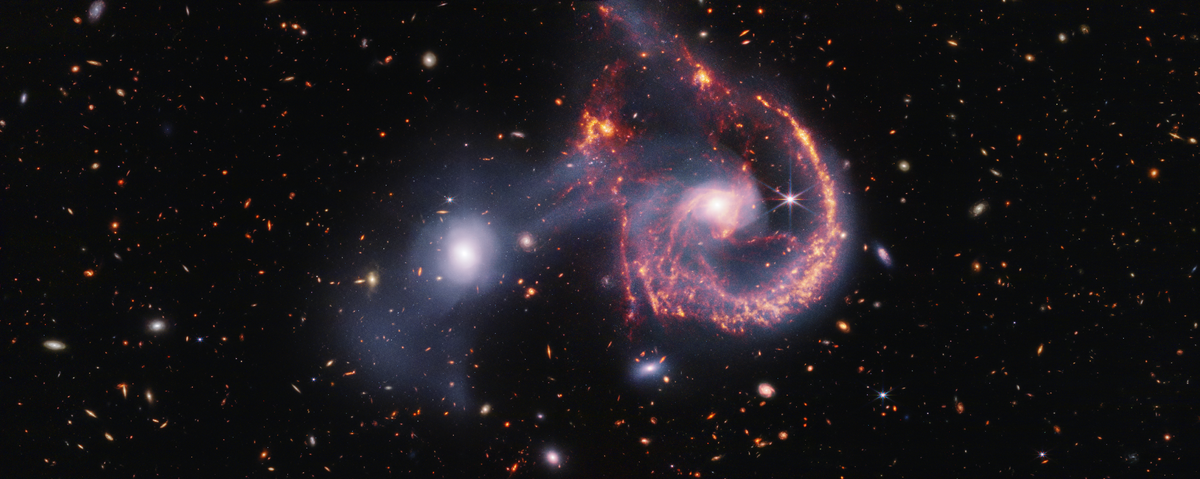
"One perennial question I get concerns cosmology (an understandably puzzling topic): If the universe is expanding, how can galaxies collide? Shouldn't they be flying away from each other, not toward one another? There are actually two reasons galaxies can collide in an expanding cosmos. One is that the expansion only dominates on very large scales, and the other is that the expansion competes against gravity."
The universe is expanding, meaning space itself stretches rather than galaxies moving through space. The expansion causes more distant galaxies to appear to recede faster, following Hubble's law. Expansion dominates on very large scales, but on smaller, gravitationally bound scales mutual gravity and local motions can overcome expansion. Galaxies within groups and clusters remain bound and can move toward one another, sometimes colliding. Therefore galaxy collisions are possible even as the overall cosmos expands. The competition between gravity and expansion determines whether systems remain bound or are carried apart by cosmic expansion.
Read at www.scientificamerican.com
Unable to calculate read time
Collection
[
|
...
]