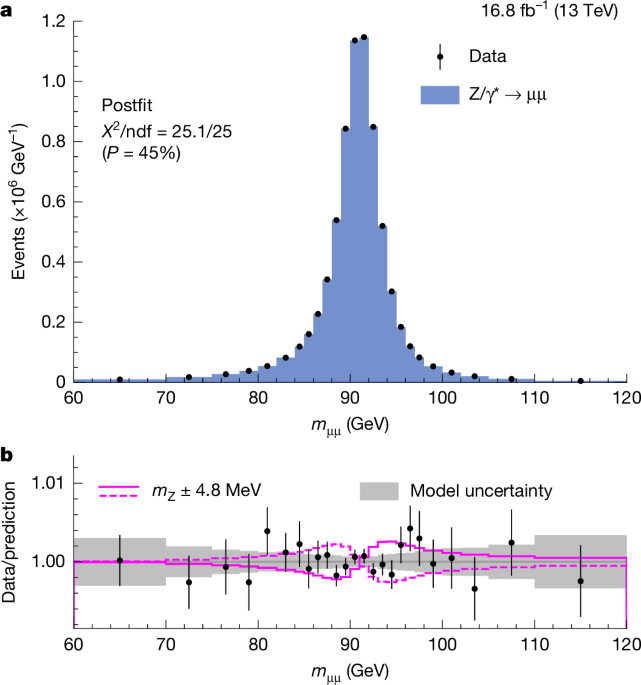
Precision measurements of fundamental parameters have significantly contributed to the standard model of particle physics, particularly in estimating the masses of W and Z bosons, top quark, and Higgs boson. The discovery of the Higgs boson at CERN's LHC has constrained all parameters in the electroweak sector. However, the standard model is considered incomplete as it fails to explain the matter-antimatter asymmetry and dark matter. Deviations in the masses and couplings of W and Z bosons could indicate new physics beyond the standard model.
"Precision measurements of fundamental parameters have played a major part in the development of the standard model of particle physics, providing accurate descriptions of known elementary particles and their interactions."
"The observation of the Higgs boson at the CERN Large Hadron Collider and the determination of its mass have constrained all parameters in the electroweak sector of the standard model."
"The standard model is widely believed to be incomplete, as it does not explain certain fundamental observations, such as the asymmetry of matter and antimatter in the universe and the existence of dark matter."
"If the measured masses and couplings of the W and Z bosons deviated from the predicted relation, it would indicate physics beyond the standard model, potentially due to new particles interacting with the W and Z bosons."
Read at Nature
Unable to calculate read time
Collection
[
|
...
]