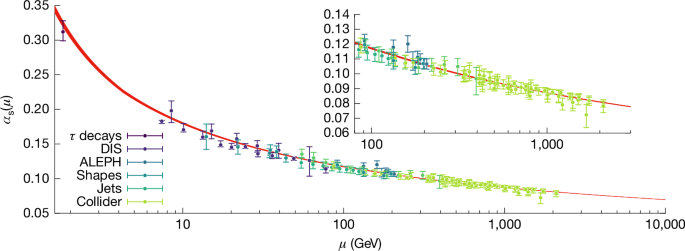
The strong nuclear force between nucleons is explained by quantum chromodynamics, involving quarks and gluons. This force is weak at high energies but strong at nuclear distances, leading to confinement where quarks and gluons cannot be observed directly. Instead, only composite states like protons and neutrons are detected. The quark-gluon coupling depends on the energy scale and its definition. Due to confinement, direct measurements are impossible, leading to uncertainties in estimating the strong coupling, with systematic uncertainties complicating the determination of a world average.
"The interaction between quarks and gluons is characterized by being weak at very high energies and short distances, a phenomenon known as asymptotic freedom, whereas it is so strong at nuclear distances that thinking of quarks and gluons as individual particles makes no sense at all."
"Fundamental quarks and gluons cannot be directly observed, but instead, only composite 'colour-neutral' states, such as protons, neutrons or π-mesons, are observed in experiments."
"Different categories still exhibit uncertainties in the range of 1.5-3%, which are not simply due to the limited precision of the experimental data, but include significant systematic uncertainties originating from the lack of an analytic understanding of confinement."
Read at Nature
Unable to calculate read time
Collection
[
|
...
]