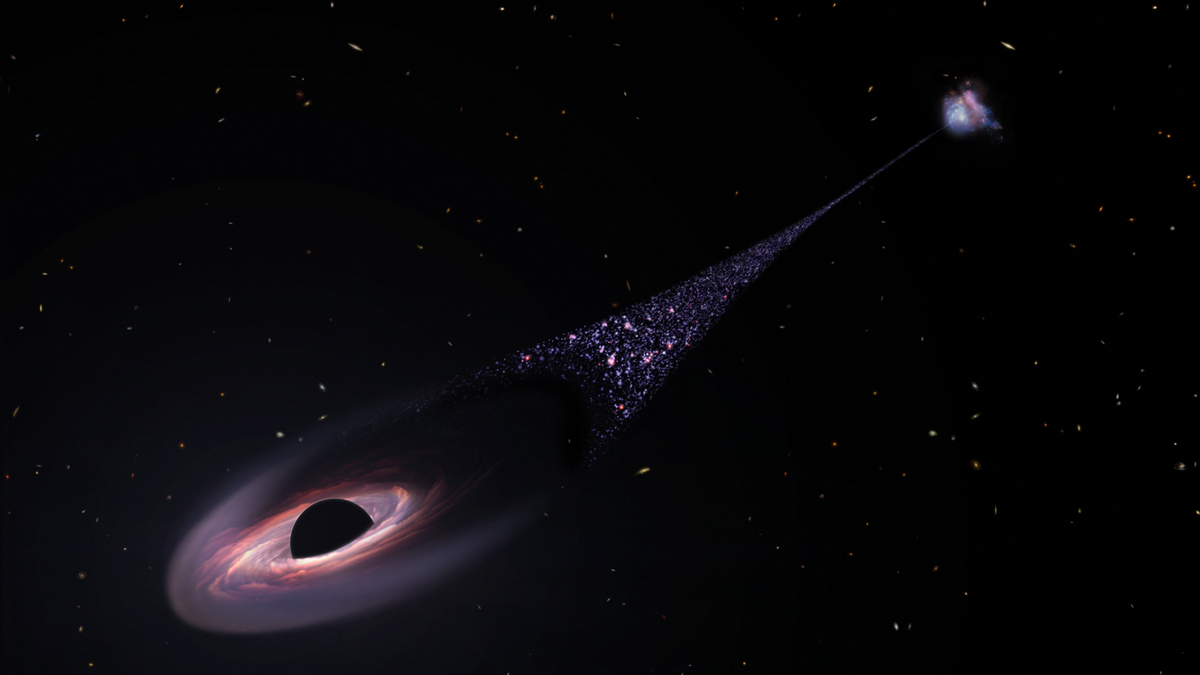
"There is something inherently terrifying about a supermassive black hole hurtling through space at an excess of three million kilometers per hour. Normally these behemoths squat at the centers of galaxies and for good reason; they're usually the single most massive objects in their host galaxy and thus aren't easily budged. But then there's RBH-1."
"This uncertainty may be the oddest part of the whole story: not that a runaway giant black hole might exist but that the data are so ambiguous that we can't be sure what we're really seeing. Even more fun, astronomers discovered RBH-1 by accident! They were examining routine Hubble Space Telescope observations of a nearby dwarf galaxy when they spotted something peculiar: a long, linear streamer of light aligned with a distant galaxy."
"Follow-up observations that obtained and analyzed this structure's spectrum—its brightness versus color, which can reveal a host of information about the emitting object—revealed it to be about 7.7 billion light-years away from Earth. This means it's quite large, approximately 200,000 light-years in length—about twice the width of our Milky Way galaxy. The spectrum also shows the structure is a mix of gas and stars."
RBH-1 represents an unusual astronomical discovery: a possible runaway supermassive black hole moving through space at extreme velocity, contrary to the typical behavior of such objects which remain anchored at galaxy centers. Astronomers accidentally discovered this phenomenon while examining Hubble Space Telescope observations of a nearby dwarf galaxy. They identified a peculiar linear streamer of light extending approximately 200,000 light-years, roughly twice the width of the Milky Way. Spectral analysis revealed the structure contains gas and stars, with a bright knot at one end glowing as intensely as 50 million suns. The discovery team proposed multiple interpretations for this structure, including galactic collision debris or stripped gas, reflecting the ambiguity surrounding what RBH-1 actually represents.
#runaway-black-holes #astronomical-discovery #hubble-space-telescope #galaxy-dynamics #supermassive-black-holes
Read at www.scientificamerican.com
Unable to calculate read time
Collection
[
|
...
]