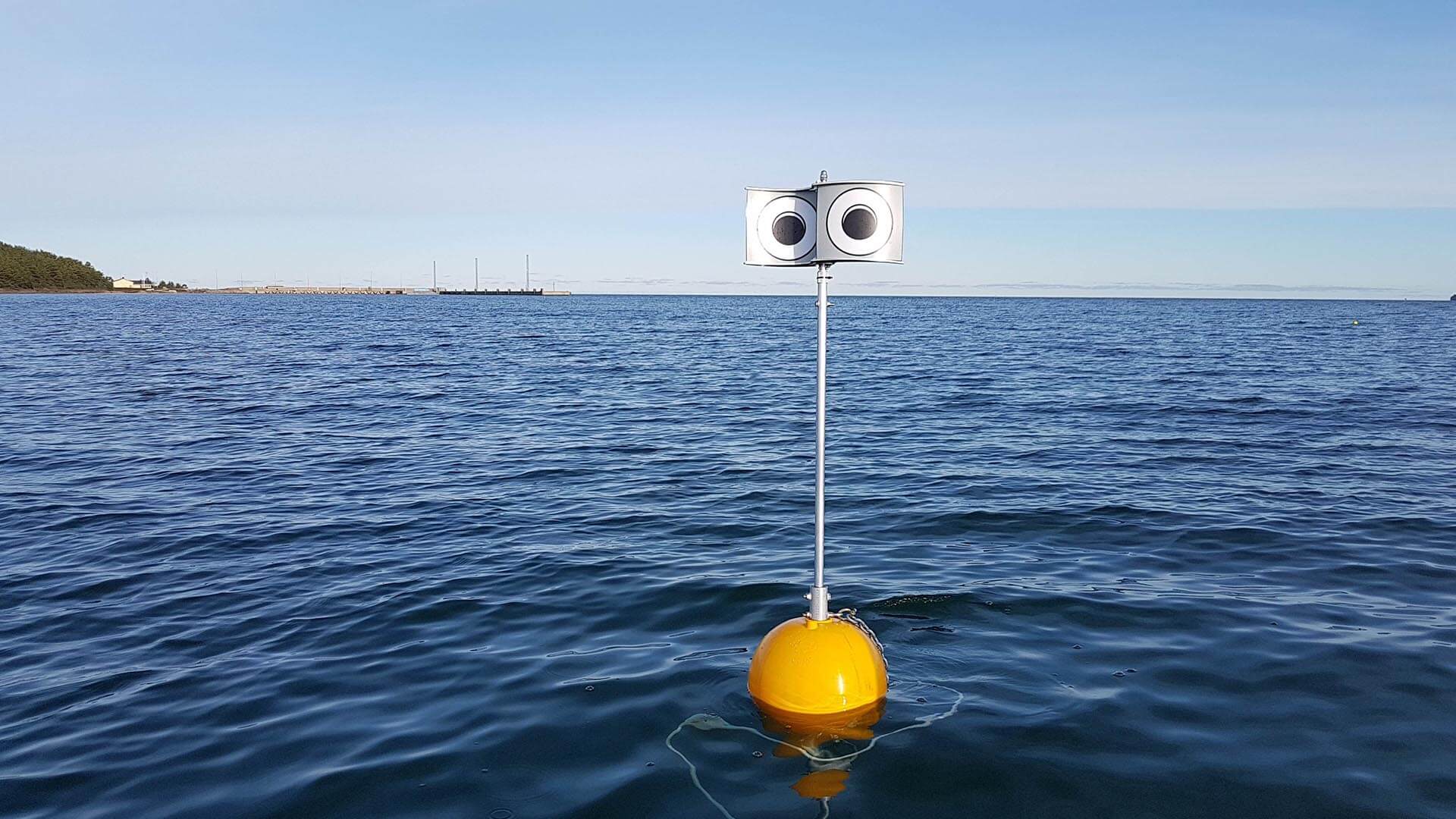
Fisheries in the Western Baltic Sea use pound nets to funnel migrating mackerel and needlefish into smaller sections where fish are trapped and emptied every few days. While fish remain idle in the nets, seabirds such as cormorants, gulls, and terns feed on them, and gulls can steal catches from cormorants. Fishers have tried covering the catch and adding artificial refuges, but birds still access the nets, and increased netting can lead to tangled or drowned seabirds. Scientists estimate large numbers of seabirds die annually from diving into gillnets. New deterrents were tested, including high-contrast panels and bright LED lights, but they did not work reliably. Looming eyes buoys use conspicuous, wind-moved eyes to trigger collision-risk behavior in birds, and similar devices have deterred birds at airports.
"In the Western Baltic Sea, fisheries target migrating mackerel and needlefish with pound nets, which funnel passing shoals into a series of smaller nets until they are trapped. The traps are emptied every few days, but as the caught fish idle in the nets, they become quite attractive to passing seabirds, such as cormorants, gulls, and terns. The cormorants sample the fish like a charcuterie board and various enterprising gulls steal the cormorants' catches. Several dozen birds can likely be found loitering near any particular pound net, and their ravenous appetites result in real losses for the fisheries."
"Fishers have attempted to fight back in various ways. They've tried covering their catch with a netted cover or providing the fish artificial refuges. But the birds are relentless, and the agile cormorants simply entered the pound nets from below. And the more protective netting the fishers added, the more they found tangled or drowned seabirds alongside their catch. A paper from 2021 estimated that 400,000 seabirds are killed by diving into gillnets each year."
"Scientists have been cooking up new strategies to reduce the number of seabirds snacking on, and dying in, pound nets. They tried high-contrast panels and bright LED lights, but nothing seemed to work. That is, until Bobby the buoy entered the picture. Here is a buoy similar to Bobby: Rouxel, et al. (2021) Bobby is a device called a "looming eyes buoy," which scientists invented to exploit the idea that a conspicuous pair of eyes is likely to deter birds by triggering a collision-risk signal in their brains."
"The wind makes the eyes move, giving the impression that the eye size is changing, like a predator approaching. Now witness the fearsome nature of Bobby! Scientists have tested out looming eyes at airports, where they have successfully deterred raptors, corvids, and other birds from dr"
Read at Defector
Unable to calculate read time
Collection
[
|
...
]