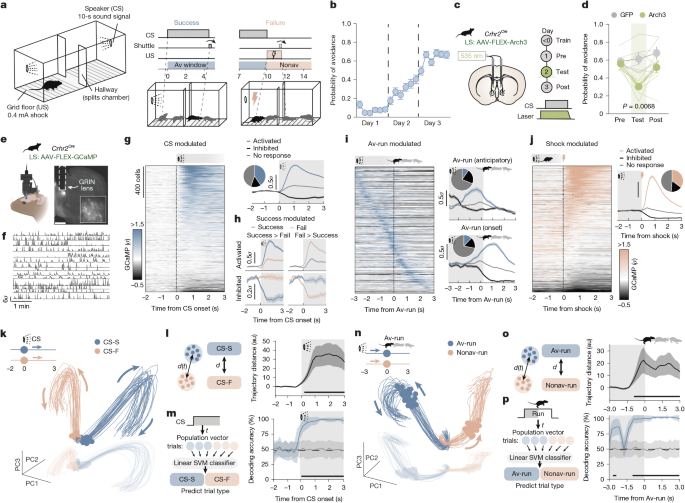
LSCrhr2 lateral septum neurons integrate sensory information with internal state and prior experience to regulate defensive behavior. Single-cell calcium imaging, molecular sequencing, and circuit dissection reveal spatial and functional organization of LS cell types and the computations they perform. LSCrhr2 population activity is required for cue-driven defensive actions by rapidly and dynamically encoding threat representations that predict behavioral outcomes. Threat representations arise from convergence of multiple signals represented by distinct LSCrhr2 subclasses. Subclasses differ by molecular features, spatial locations, and input architectures. Hippocampal and hypothalamic afferents preferentially provide cue- and action-related signals that shape these representations.
"The ability to rapidly detect and evaluate potential threats is essential for survival and requires the integration of sensory information with internal state and previous experience. The lateral septum (LS—an inhibitory structure in the limbic forebrain) is thought to integrate these higher-order cognitive signals to regulate defensive responses. However, the cellular, circuit and computational mechanisms fundamental to this process remain unknown."
"Here we focus on the population of LS neurons that express the type 2 CRH receptor (LSCrhr2), a neuronal subset shown to be critical for state-dependent behavioural changes and threat responsivity in mice. We use a combination of single-cell calcium imaging, molecular sequencing and circuit dissection to reveal the spatial and functional organization of the cell types involved, the computations they perform and the information relayed by their upstream activators."
"We determine that LSCrhr2 population activity is required for cue-driven defensive actions by rapidly and dynamically encoding threat representations that predict behavioural outcomes. We find that these threat representations are formed through the convergence of various signals differentially represented by distinct LSCrhr2 subclasses, which are defined by their molecular features, spatial locations and input architectures."
"Notably, these responses reflect specific afferents from the hippocampus and hypothalamus that preferentially impart cue- and action-related signals, res"
Read at www.nature.com
Unable to calculate read time
Collection
[
|
...
]