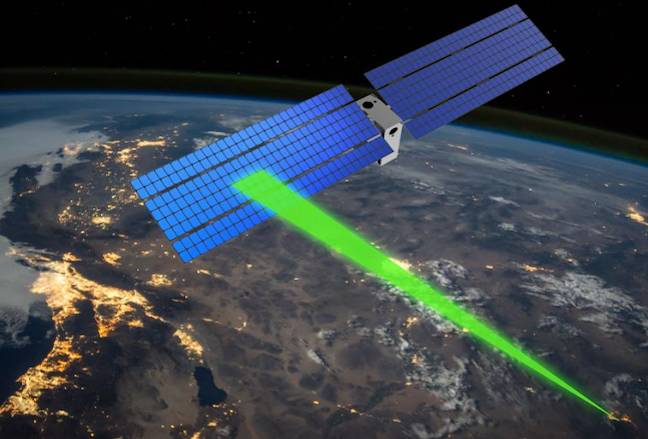
"Establishing laser links between moving targets at this distance is technically very challenging. Continuous movements, platform vibrations and atmospheric disturbances require extreme precision. This milestone is a further development of our long successful laser communication history; it opens the door to a new era of laser satellite communications to meet defence and commercial needs in the next decades."
"The uplink hinges on high-precision pointing closed-loop control, achieved through micro-radius-level dynamic tracking and real-time compensation using beacon light, ensuring the continuous and accurate projection of 1Gbps signal light onto the satellite. The downlink sees integration of a high-order adaptive optics system and mode diversity coherent reception technology."
The ESA successfully demonstrated a 2.6 gigabits per second error-free laser link to the Alphasat TDP 1 satellite at 36,000 km altitude using an Airbus-made terminal. China's Institute of Optoelectronics independently achieved a 1 gigabit per second symmetrical link to a satellite 40,000 km away using a 1.8-meter laser ground station, establishing connection in four seconds and maintaining it for three hours. Both achievements overcome significant technical challenges including platform vibrations, atmospheric disturbances, and extreme precision requirements. The technologies employ advanced systems including high-precision pointing control, adaptive optics for atmospheric correction, and coherent reception technology to maintain stable, high-speed data transmission across vast distances.
#satellite-laser-communication #gigabit-data-transmission #geostationary-orbit #optical-ground-stations #atmospheric-compensation-technology
Read at Theregister
Unable to calculate read time
Collection
[
|
...
]