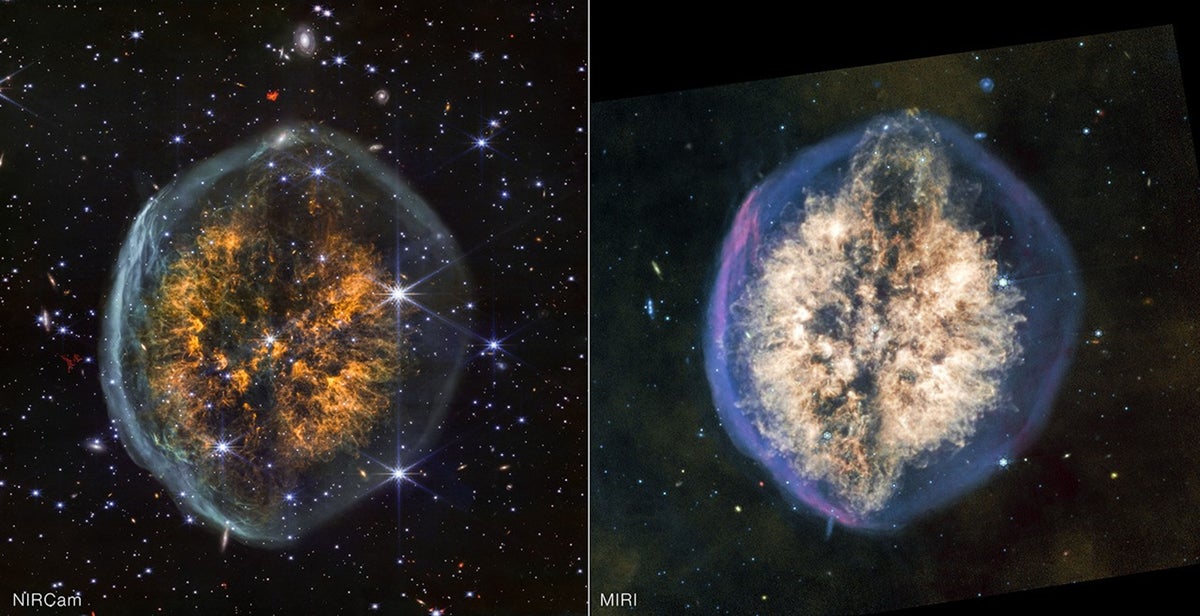
The James Webb Space Telescope has revealed striking new images of the Exposed Cranium nebula (Nebula PMR 1), located 5,000 light-years away in the constellation Vela. This massive dying star resembles a brain within a skull as it sheds its outer material, creating billowing clouds of gas and dust. The images, captured in near- and mid-infrared light, show a dark channel running through the center of the gas clouds, similar to the brain's longitudinal fissure. This feature likely results from jets expelled by the dying star pushing inner gas outward. The outer gas layer consists primarily of hydrogen, while inner clouds contain more complex elements. The star's ultimate fate depends on its mass: sufficiently massive stars will explode as supernovae, while smaller ones will become white dwarfs and eventually theoretical black dwarfs.
"New images captured by the James Webb Space Telescope reveal what looks eerily like a brain floating in space, housed inside a semi-transparent skull. This is the Exposed Cranium nebula, also known as Nebula PMR 1. Located some 5,000 light-years away in the constellation Vela, it's a massive, moribund star coming to the end of its fuel-burning life."
"The new images show the nebula in both near- and mid-infrared light, revealing a dark channel that runs through the middle of the clouds of gas and dust—just like the longitudinal fissure that separates our brain's right and left hemispheres. In the nebula, this feature may be caused by jets coming from the dying star, pushing the inner gas out."
"If it is massive enough, it will explode into a supernova. But if not, it will deteriorate until only its core remains, at which point it will become a white dwarf, a dense object that astronomers believe cools over time to become a black dwarf—a cold, dark object that exists only in theory."
Read at www.scientificamerican.com
Unable to calculate read time
Collection
[
|
...
]