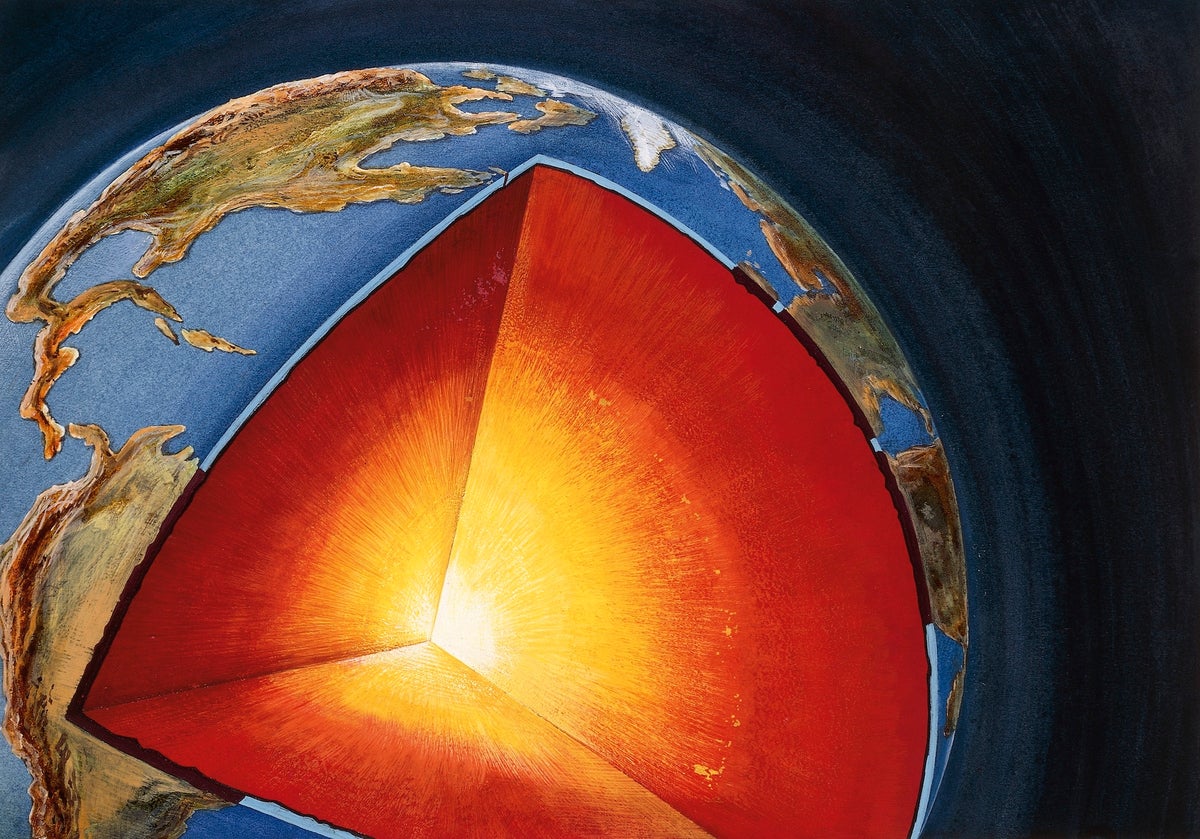
"Earth's core is mostly made of iron, but it's not quite dense enough to be entirely composed of that element. Teasing out what percentages of lighter elements make up the core can reveal a lot about how the planet formed. But the core is too distant to measure directly, so researchers have to rely on computer simulations and high-temperature laboratory experiments that squeeze tiny amounts of various elements in diamond anvil cells under the temperatures and pressures of the center of Earth."
"Hydrogen is a slippery element in these experiments, however, because it is so light and diffuses easily, says Anat Shahar, a planetary scientist at the Carnegie Institution for Science in Washington, D.C., who was not involved in the new research. In the new study, Dongyang Huang, a professor of Earth and space sciences at Peking University in China, and his colleagues found a way to pin down hydrogen."
Earth's core may contain up to 45 oceans' worth of hydrogen. That quantity implies formation from a gas-and-dust protoplanetary disk rich in hydrogen and suggests water was incorporated during planetary formation rather than delivered later by cometary or icy impacts. Core density shortfalls require lighter elements in addition to iron, and hydrogen can contribute to that lower density. High-pressure, high-temperature experiments using diamond anvil cells compressed iron and hydrous silicate glass to simulate core–magma ocean interactions and to quantify hydrogen partitioning. Special experimental methods were used to constrain hydrogen despite its light, diffusive nature.
Read at www.scientificamerican.com
Unable to calculate read time
Collection
[
|
...
]