"Perles, C. La Prehistoire du Feu (Masson, 1977). Roebroeks, W. & Villa, P. On the earliest evidence for habitual use of fire in Europe. Proc. Natl Acad. Sci. USA 108, 52095214 (2011). Article CAS PubMed PubMed Central Google Scholar Wrangham, R. Control of fire in the Paleolithic: evaluating the cooking hypothesis. Curr. Anthrop. 58, S303S313 (2017). Article Google Scholar"
"Gowlett J. A. J. in Sur le chemin de l'humanite. Via humanitatis: les grandes etapes de l'evolution morphologique et culturelle de l'Homme: emergence de l'etre humain (ed. de Lumley, H.) 171197 (Academie Pontificale des Sciences/CNRS, 2015). James, S. R. Hominid use of fire in the Lower and Middle Pleistocene: s review of the evidence. Curr. Anthropol. 30, 126 (1989). Article Google Scholar Sandgathe, D. M. et al. Timing of the appearance of habitual fire use. Proc. Natl Acad. Sci. USA 108, E298 (2011). Article CAS PubMed PubMed Central Google Scholar"
"Goldberg, P., Miller, C. E. & Mentzer, S. M. Recognizing fire in the Paleolithic archaeological record. Curr. Anthrop. 58, S175S190 (2017). Article Google Scholar Gowlett, J. A. J. et al. Early archaeological sites, hominid remains and traces of fire from Chesowanja, Kenya. Nature 294, 125129 (1981). Article CAS PubMed Google Scholar Bellomo, R. V. Methods of determining early hominid behavioural activities associated with the controlled use of fire at FxJj 20 Main, Koobi Fora, Kenya. J. Hum. Evol. 27, 173195 (1994). Article Google Scholar Hlubik, S. et al. Researching the Nature of fire at 1.5 Mya on the site of FxJj20 AB, Koobi Fora, Kenya, using high-resolution spatial analysis and FTIR spectrometry. Curr. Anthrop. 58, S243S257 (2017). Article Google Scholar Brain, C. K. & Sillen, A. Evidence from the Swartkrans cave for the earliest use of fire. Nature 336, 464466 (1988). Article CAS Google Scholar Berna, F. et al. Microstratigraphic evidence of in situ fire in the Acheulean strata of Wonderwerk Cave, Northe"
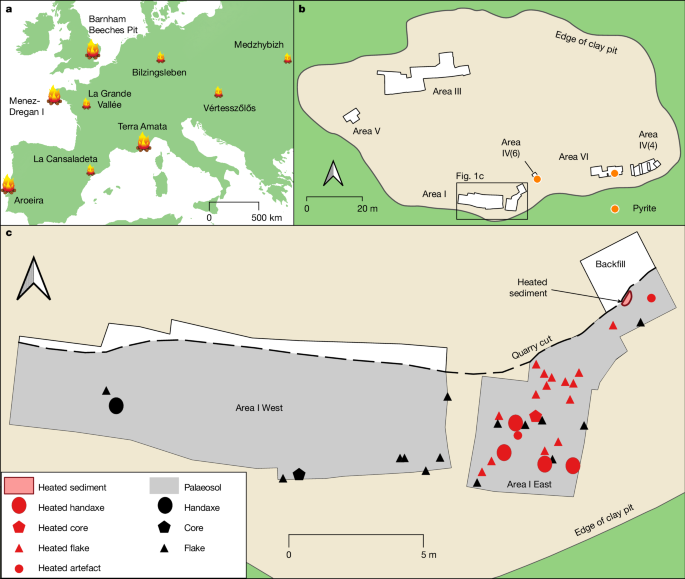
Evidence indicates early hominin control and use of fire at multiple African and European sites, including Chesowanja, Koobi Fora, Swartkrans, and Wonderwerk Cave. The temporal range spans the Lower and Middle Pleistocene with debates about timing and habitual versus occasional use. Analytical approaches include microstratigraphy, FTIR spectrometry, high-resolution spatial analysis, and taphonomic criteria for recognizing burned materials. Interpretations engage with functional hypotheses such as cooking and behavioural inferences about hominin activities. Methodological rigor and site-specific data are central to distinguishing in situ fire use from natural burning and post-depositional processes.
Read at www.nature.com
Unable to calculate read time
Collection
[
|
...
]