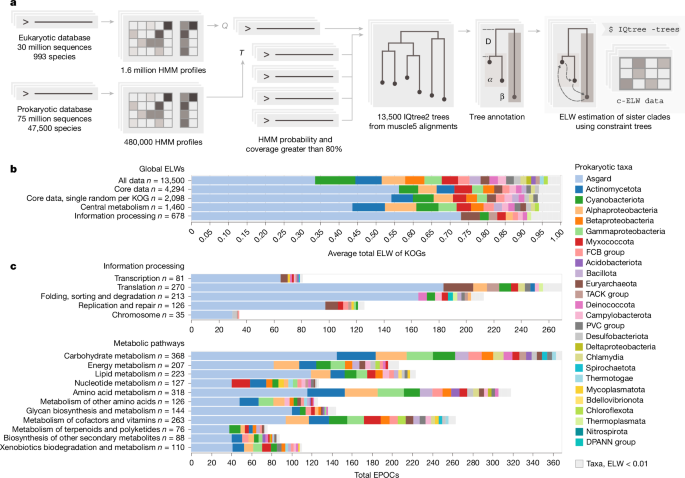
Eukaryotic cells feature a nucleus, endomembrane system, complex cytoskeleton and mitochondria derived from an alphaproteobacterial endosymbiont. Early models proposed an amitochondrial protoeukaryote that later acquired mitochondria, but no primary amitochondrial eukaryotes have been identified and many lineages show secondary mitochondrial loss. The last eukaryotic common ancestor (LECA) likely already contained mitochondria and canonical eukaryotic cellular structures. Phylogenomic analyses attribute core LECA genes to both archaeal and bacterial sources, with archaeal genes enriched in information-processing systems and bacterial genes encoding operational and metabolic functions. Discovery of Asgard archaea identifies the closest archaeal relatives to eukaryotes and refines phylogenetic placement.
"Eukaryotes drastically differ from archaea and bacteria (collectively, prokaryotes) by the complex organization of eukaryotic cells. The signature features of this organizational complexity include the eponymous nucleus, the endomembrane system, the elaborate cytoskeleton and the energy-converting mitochondrion, which evolved from an alphaproteobacterial endosymbiont9. Thus, the last eukaryotic common ancestor (LECA) probably already possessed mitochondria along with the other signatures of the eukaryotic cellular organization."
"Phylogenomic analyses show that the core genes of eukaryotes that can be traced to the LECA are a mix originating from archaea and various bacteria and, in early studies, the bacterial contributions quantitatively exceeded the archaeal ones1. The archaea-derived genes were found primarily in information-processing systems (replication, transcription and translation), whereas genes of apparent bacterial origin comprised the operational component of the eukaryotic gene complement, in particular encoding metabolic enzymes16,17,18,19."
Read at Nature
Unable to calculate read time
Collection
[
|
...
]