"We find one such illus­tri­ous fig­ure in the Han dynasty of the first and sec­ond cen­turies: a states­man named Zhang Heng (78-139 AD), who man­aged to dis­tin­guish him­self across a range of fields from math­e­mat­ics to astron­o­my to phi­los­o­phy to poet­ry. His accom­plish­ments in sci­ence and tech­nol­o­gy include invent­ing the first hydraulic armil­lary sphere for observ­ing the heav­ens, improv­ing water clocks with a sec­ondary tank, cal­cu­lat­ing pi fur­ther than it had been in Chi­na to date,"
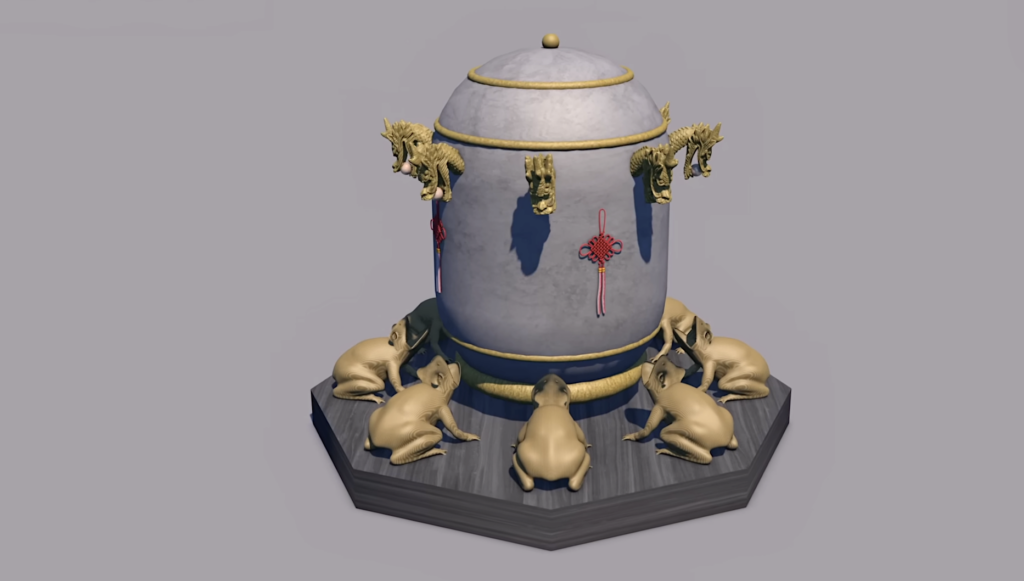
"His seis­mo­scope, its nar­ra­tor says, "was called hòufēng dìdòngyí, which means 'instru­ment for mea­sur­ing sea­son­al winds and move­ments of the earth,' " and it could "deter­mine rough­ly the direc­tion in which an earth­qua­ke occurred." Each of its eight drag­on heads (a com­bi­na­tion of num­ber and crea­ture that, in Chi­na, could hard­ly be more aus­pi­cious) holds a ball; when the ground shook, the drag­on point­ing toward the epi­cen­ter of the quake drops its ball into the mouth of one of the dec­o­ra­tive toads wait­ing below."
Zhang Heng (78–139 AD) was a Han dynasty statesman and polymath who excelled in mathematics, astronomy, philosophy, and poetry. He invented the first hydraulic armillary sphere for celestial observation and improved water clocks by adding a secondary tank. He calculated pi more precisely than previous Chinese estimates and made discoveries about the moon. He assembled the first seismoscope, called hòufēng dìdòngyí, designed to indicate the direction of earthquakes. The device used eight dragon heads holding balls that would drop into toads' mouths beneath when a quake occurred, showing the quake's approximate direction.
Read at Open Culture
Unable to calculate read time
Collection
[
|
...
]