"Dark matter, an invisible yet gravitationally interacting component of the Universe16,17,18, remains one of the most profound unsolved mysteries in modern physics. Although experiments focusing on weakly interacting massive particles have successfully approached the neutrino fog1,2,3,4,5,6,7,8,9,10, conclusive evidence for dark matter has yet to be found. The dark matter is broadening its focus. A global experimental effort is now probing models in which the dark matter particle has a mass roughly between MeV and GeV."
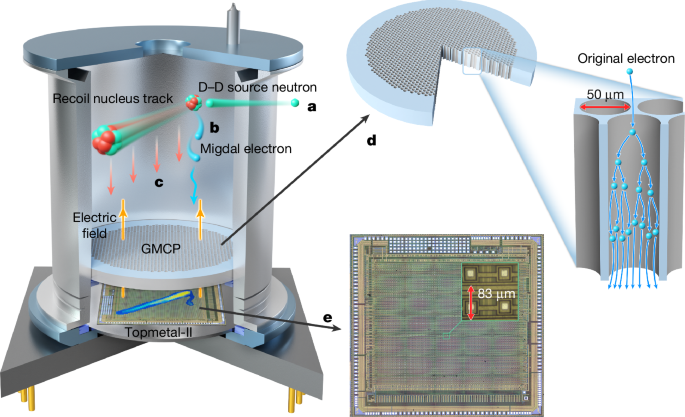
"A promising new strategy to tackle this challenge is the Migdal effect. It describes a process in which energy transfers from an atomic nucleus to a surrounding electron13,14,15. When a neutral particle, such as dark matter or a neutron, interacts with an atomic nucleus, it causes the nucleus to recoil. Along with this recoil, an additional electronic recoil is produced because of the excitation of atomic electrons. This additional component can generate a signal in the detectors that is above the energy threshold."
Dark matter remains an unresolved problem despite extensive searches for weakly interacting massive particles and progress toward the neutrino background. Experimental programs are expanding to target dark matter masses in the MeV–GeV range, supported by theoretical models allowing successful thermal production. Present detector thresholds near 100 eV in tonne-scale experiments are insufficient for many light-dark-matter signals. The Migdal effect transfers some nuclear-recoil energy to atomic electrons, producing additional electronic recoils that can exceed detector thresholds. The Migdal mechanism has been reformulated and further studied theoretically, and global efforts are investigating its use to enhance direct-detection sensitivity to light dark matter.
Read at Nature
Unable to calculate read time
Collection
[
|
...
]