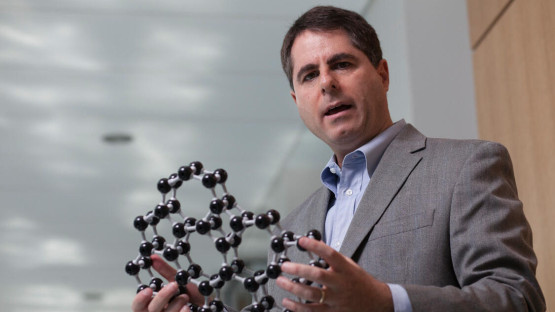
David Muller was elected to the National Academy of Engineering for developing the world's highest-resolution electron microscope and advancing atomic-scale materials characterization. His work expanded fundamental understanding of matter and enabled insights into renewable energy, semiconductor devices, biology, and other fields. He developed new electron detectors and reconstruction algorithms that produced a microscope which in 2021 set a world resolution record, resolving atoms with blur limited only by thermal motion. His collaborations produced the world's thinnest sheet of glass at two atoms thick, revealing the individual arrangement of glass atoms. He serves as a widely consulted imaging and materials-discovery leader.
"Muller was elected for his advances in atomic-scale electron microscopy and materials characterization, which have expanded the fundamental understanding of matter and enabled new insights into renewable energy, semiconductor devices, biology and other research fields. His development of a new electron detectors and reconstruction algorithms resulted in an electron microscope that, in 2021, its own world record for resolution, capturing an image of atoms with such precision that the only remaining blur came from the atoms' own thermal motion."
""David's extraordinary influence extends far beyond his own research," said Lynden Archer, the Joseph Silbert Dean of Engineering. "Across campus and across continents, researchers turn to him for insight. He has helped shape how an entire community approaches imaging and materials discovery." One example of that impact came in 2013 when, working with scientists at Cornell and Germany's University of Ulm, Muller the world's thinnest sheet of glass. At just two atoms"
#electron-microscopy #materials-characterization #atomic-scale-imaging #national-academy-of-engineering
Read at Cornell Chronicle
Unable to calculate read time
Collection
[
|
...
]