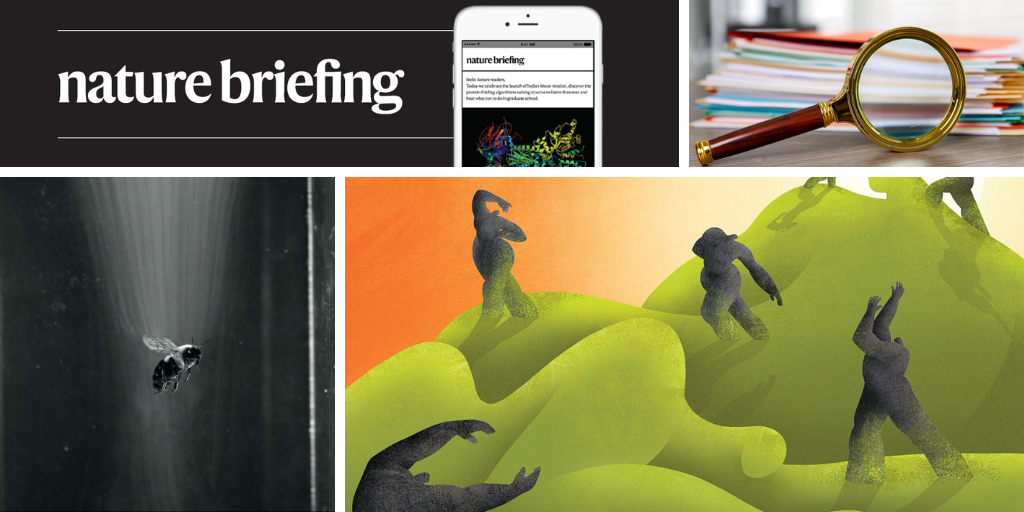
"The breeze that bumble bees ( Bombus impatiens) generate by flapping their wings stops them from overheating as they hover in place. To hover, bees' large wing muscles must work overtime, which generates heat. Researchers found that the insects counteract this warmth by creating a downbreeze that can lower their body temperature by around 5 °C, which could explain how they can stay aloft for long periods even on hot days."
"Researchers in France and the Netherlands are offering funds and resources to nanoscientists to try to replicate a landmark finding that quantum dots can act as biosensors inside living cells. The project, called NanoBubbles, is part of the first large-scale effort in the physical sciences to tackle the reproducibility crisis. The team decided to recruit other researchers after they failed to replicate the results in question themselves. "We are trying to use replication as a tool to solve a controversy or, you know, to get closer to the truth," says physicist and NanoBubbles co-lead Raphaël Lévy."
More adults are receiving autism diagnoses, and there is limited knowledge about how autism influences ageing and later-life outcomes. Bumble bees (Bombus impatiens) produce a wing-generated downbreeze that reduces body temperature by about 5 °C, enabling prolonged hovering even in hot conditions. The NanoBubbles project in France and the Netherlands funds replication attempts to test whether quantum dots function as biosensors inside living cells, addressing reproducibility problems after initial replication failures. An international team recovered a 228-metre core from beneath the West Antarctic Ice Sheet, with fossil algae indicating an archive spanning roughly 23 million years and informing past ice-sheet retreat.
#adult-autism #ageing #bumblebee-thermoregulation #reproducibility-in-nanoscience #antarctic-ice-core
Read at Nature
Unable to calculate read time
Collection
[
|
...
]