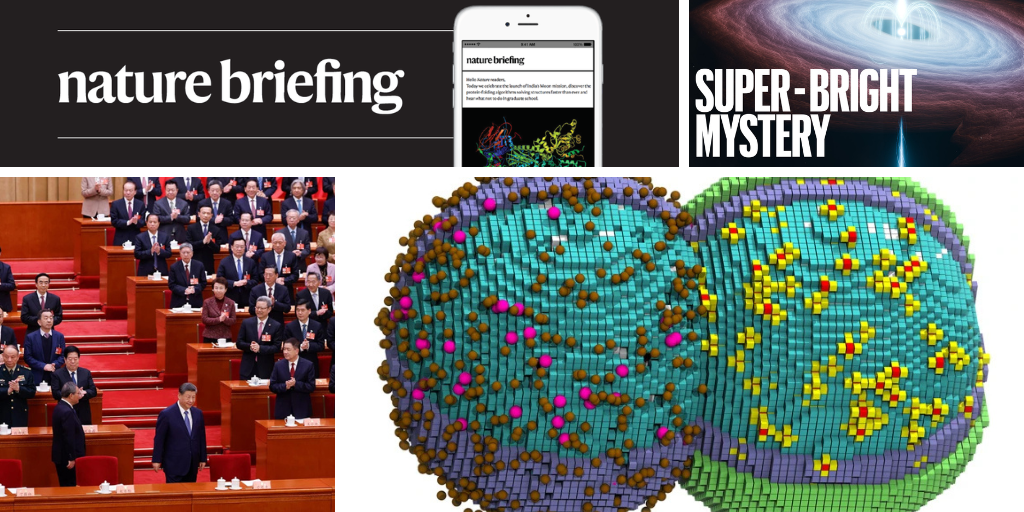
"Researchers have created a 3D simulation that models DNA replication, cell division and nearly every chemical reaction in a living bacterial cell. This 'virtual cell' isn't a totally faithful recreation of the organism - the team used placeholders for some genes with unknown functions, for example. But it could help researchers understand how the mix of molecules in a cell gives rise to actual life."
"The Chinese government has announced plans to increase two of its key science budgets at the country's biggest political meeting. The government proposes to increase its science and technology budget by 10% this year, and its overall research and development expenditure by at least 7% per year over the next five years - a boost that translates to billions of extra dollars each year."
"Researchers have, for the first time, cryogenically frozen and then revived mouse brains with some of the brain functionality intact. The team used an ice-free method called vitrification, which preserves tissue in a glass-like state, and a thawing process that preserves living tissue. After the brains were warmed up, wafer-thin slices from the hippocampus showed signs that the structures that support learning and memory had survived."
Scientists developed a computational simulation of a bacterial cell that recreates DNA replication, cell division, and nearly all chemical reactions occurring within the organism. While the model uses placeholder functions for genes with unknown purposes, it provides a valuable tool for understanding how molecular composition and interactions produce living systems. Computational biophysicist Zane Thornburg notes this virtual cell could advance comprehension of life's fundamental mechanisms. Additionally, China announced significant science funding increases, boosting its science and technology budget by 10% and committing to at least 7% annual research and development growth through 2030. Separately, researchers successfully cryogenically froze and revived mouse brains using vitrification, preserving brain tissue in a glass-like state with some functionality intact after thawing.
#virtual-cell-simulation #computational-biology #china-science-funding #brain-cryopreservation #vitrification-technology
Read at Nature
Unable to calculate read time
Collection
[
|
...
]