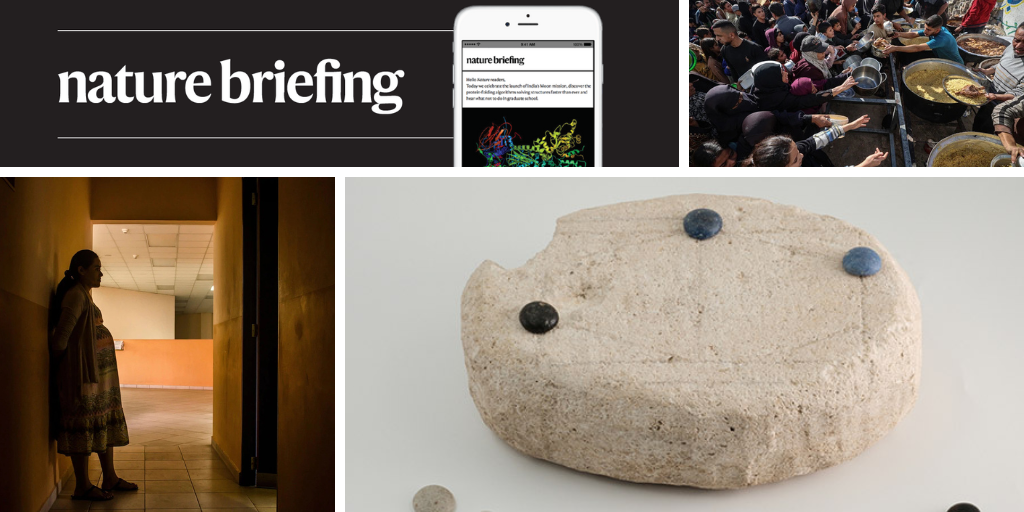
"Researchers say they have figured out the rules of an ancient Roman board game. The team simulated thousands of turns based on more than 100 games that could be played on the linked lines inscribed on a stone found in the Roman settlement of Coriovallum, now Heerlen in the Netherlands. One set of rules best matched the wear-and-tear on the stone: a blocking game they've nicknamed Ludus Coriovalli ('the game from Coriovallum')."
"Young chacma baboons ( Papio ursinus) vie for their mother's attention more often when she's grooming one of their siblings than when she's free, which suggests that they get jealous of one another. Researchers found that the monkeys were more likely to interrupt their mother if she was grooming a younger sibling or one of the same sex. Their tactics included tantrums, attempts to physically come between their mother and sibling, and even tricks to lure their sibling away from their mother and take their place."
"The black hole at the centre of our Galaxy might actually be a huge blob of dark matter, suggest astrophysicists. A super-dense core of subatomic particles called fermions, spreading out into a vast, diffuse cloud, would match up with observations (and a direct image captured in 2022) equally as well as a black hole, they say. If the Milky Way really is permeated by a cloud of fermionic dark matter - and we'd need better observations to confirm it for sure -"
Astrophysicists propose that the Milky Way's central compact object could be a super-dense fermion core surrounded by a vast, diffuse cloud of fermionic dark matter that reproduces observational signatures, including the 2022 direct image, as well as a black hole; better observations are required to confirm this hypothesis. A team reconstructed rules for an ancient Roman stone board by simulating thousands of turns across more than 100 possible games and identified a blocking game, Ludus Coriovalli, that best matches wear patterns. Young chacma baboons interrupt maternal grooming of siblings, using tantrums, physical interference and luring to gain attention, indicating sibling-targeted jealousy. The humanitarian sector is urged to adopt a 'peace first' approach.
Read at Nature
Unable to calculate read time
Collection
[
|
...
]