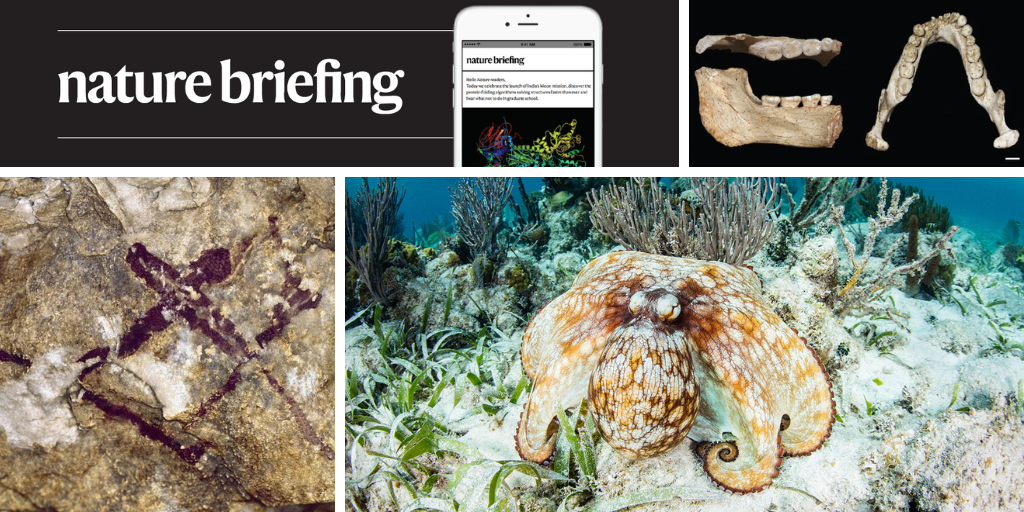
"Researchers have created a synthetic 'skin' that can change colour and texture on demand. The material can switch from matte to shiny and display a variety of other effects, before reverting to its initial state. The team used an electron beam to make a 'landscape' of bumps on the surface of a polymer that reversibly swells on contact with water. The bumps absorb varying amounts of water, which resulted in a material that could drastically change its appearance when wet. The flow of liquid can be controlled by covering the material with a transparent film."
"Traces of toxic compounds have been found on 60,000-year-old arrowheads, providing the oldest chemical evidence that Palaeolithic hunter-gatherers used poison to bring down prey. Chemical analysis revealed a compound called buphandrine, derived from the poison bulb plant ( Boophone disticha), on arrowheads discovered in KwaZulu-Natal, South Africa. The use of poisons "shows advanced planning, strategy and causal reasoning" among hunter-gatherers, says archaeologist Justin Bradfield. It also suggests that they had a complex understanding of the properties of plants, says archaeologist April Nowell."
"As mpox continues to spark localized outbreaks in Africa and elsewhere, researchers are racing to understand more about the virus that has caused two public-health emergencies in the past three years."
A synthetic polymer 'skin' can change colour and texture on demand, switching from matte to shiny and reverting to its initial state. An electron beam patterns a landscape of surface bumps on a polymer that reversibly swells on contact with water; differential water absorption by the bumps produces drastic, reversible appearance changes, and liquid flow is controllable with a transparent film. Chemical analysis of 60,000-year-old arrowheads from KwaZulu-Natal, South Africa, identified buphandrine from Boophone disticha, the oldest chemical evidence of poison use and indicative of advanced planning and plant knowledge. Researchers are also investigating mpox persistence in animal models to better understand ongoing outbreaks.
Read at Nature
Unable to calculate read time
Collection
[
|
...
]