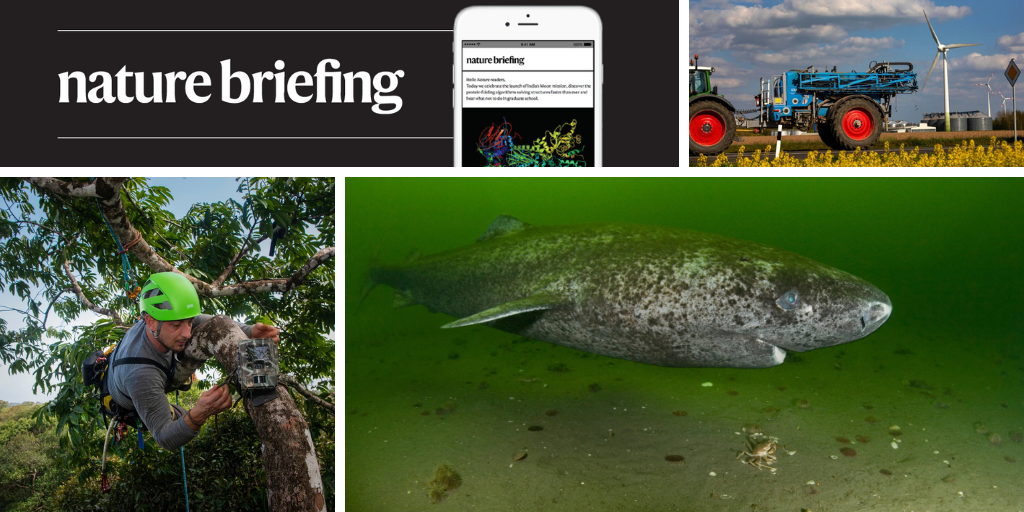
Greenland sharks can live for up to 400 years and maintain functional vision throughout extreme old age, showing no signs of retinal degeneration and indicating a DNA-repair mechanism in the retina that may protect against age-related vision loss. Parasite infestations on Greenland shark eyes had led to assumptions of functional blindness, but intact retinal health contradicts that view. US Congress spending legislation declines to fund the Mars Sample Return program and allocates US$7.25 billion to NASA, which may free resources for other missions such as two missions to Venus. Artificial-intelligence and remote-monitoring technologies are enabling ecologists to conduct more research from laboratories, expanding monitoring scale while reducing traditional fieldwork.
"They dwell in the almost-sunless waters of the Arctic deep sea, and are often infested with parasites that attach to their eyes, leading scientists to suppose that the animals might be functionally blind. But researchers who studied the sharks' eyeball in the lab say that it's quite the contrary: the sharks appear to maintain their vision over centuries with no signs of retinal degeneration - perhaps thanks to a DNA repair mechanism in the retina -"
"The US Congress has released a spending bill that backs the Trump administration's plan to terminate the Mars Sample Return (MSR) program - NASA's plan to return rocks collected by its Perseverance rover on Mars to Earth. The bill allocates the space agency US$7.25 billion for the upcoming financial year - a cut of only 1% from the previous year's allowance - but explicitly states that the funding does not support the MSR program."
Read at Nature
Unable to calculate read time
Collection
[
|
...
]