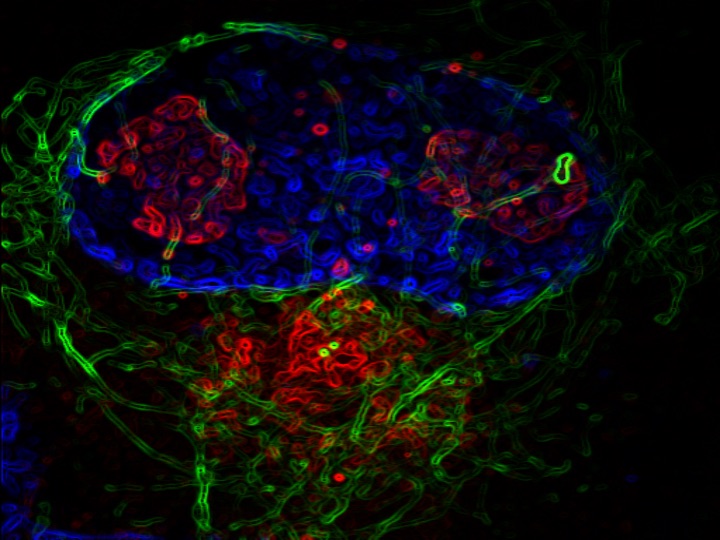
"Human cytomegalovirus (HCMV) is a DNA virus that forms lifelong infection. In healthy individuals, the immune system prevents the virus from causing illness, but the virus can be harmful those who are immunocompromised and it is the leading cause of congenital birth defects, according to the Centers for Disease Control and Prevention. During infection, HCMV replicates slowly over several days. During that time, the virus extensively remodels the infrastructure of healthy cells, including the nucleus."
"We have had a long-standing interest in understanding this cellular remodeling and in particular, how the virus exploits cytoskeletal interactions with the nucleus to control its shape and movement during infection. This is in part because a hallmark of HCMV infection is an expanded, distorted nucleus but until recently, precisely how and why this happens remained unclear. To better understand how HCMV affects nuclear movement, Walsh's team used extended live cell imaging, or timelapse imaging, to study HCMV infection over several days."
Human cytomegalovirus (HCMV) is a persistent DNA virus that can be harmful in immunocompromised individuals and causes congenital birth defects. HCMV replicates slowly over several days and extensively remodels cellular infrastructure, notably the nucleus. Extended live-cell timelapse imaging with fluorescently labeled virus and cells tracked nuclear and cellular shape changes across infection. Live and fixed imaging observed nuclear movement during later infection as the virus drove cell migration. HCMV encodes a kinase that disrupts lamin A/C organization. Lamin A/C is a filament network supporting nuclear structure, and its disruption rewires nuclear–cytoskeletal interactions to alter nuclear shape and movement.
Read at News Center
Unable to calculate read time
Collection
[
|
...
]