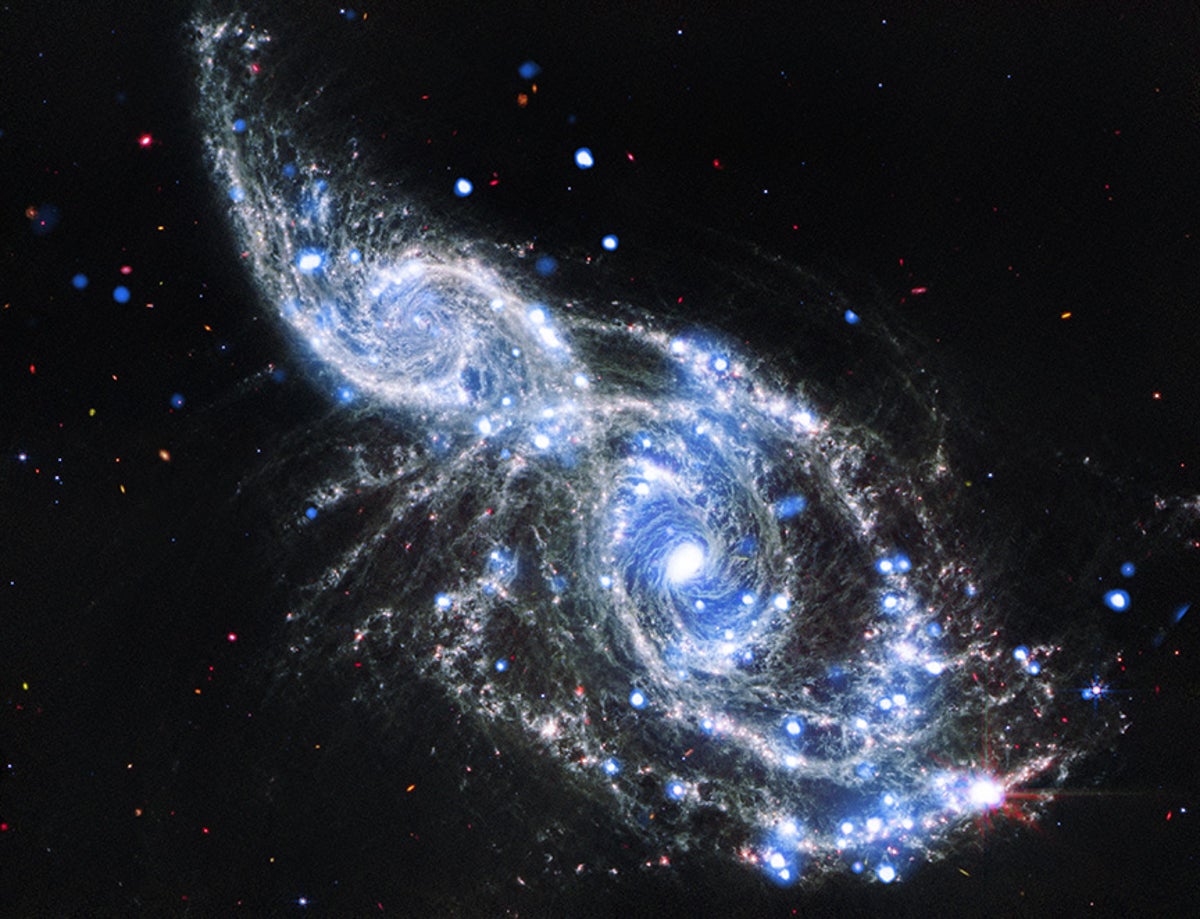
Combined JWST and Chandra observations produce a composite image of two interacting spiral galaxies, IC 2163 (left) and NGC 2207 (right), about 120 million light-years away. JWST provides mid-infrared data that highlights dust and cooler matter in white, gray, and red, while Chandra supplies X-ray data that marks high-energy regions, including intense star-forming areas, in blue. NGC 2207 is larger and is stretching and stripping material from the smaller IC 2163 during a slow gravitational interaction. The interaction will culminate in a merger billions of years from now and can trigger bursts of star formation that influence galaxy evolution.
"Two space telescopes really are better than one. This month NASA released a new image that combines observations from the James Webb Space Telescope (JWST) and the Chandra X-ray Observatory of two spiral galaxies on a cosmic collision course. The two space telescopes have very different trajectoriesgiving them each a heady vantage point on the universe. JWST orbits the sun and observes the cosmos in infrared light, whereas Chandra, which orbits Earth, is sensitive to the x-ray spectrum."
"The newly released image combines their observations into one, revealing the galaxies IC 2163 (the left-hand galaxy) and NGC 2207 (on the right) in a new light. The pair are located some 120 million light-years from Earth. The larger galaxy, NGC 2207, is slowly stretching and stripping the smaller of the pair. Together they are joined in a slow, gravitational dance that will, billions of years from now, end in their merger into a single galaxy."
Read at www.scientificamerican.com
Unable to calculate read time
Collection
[
|
...
]