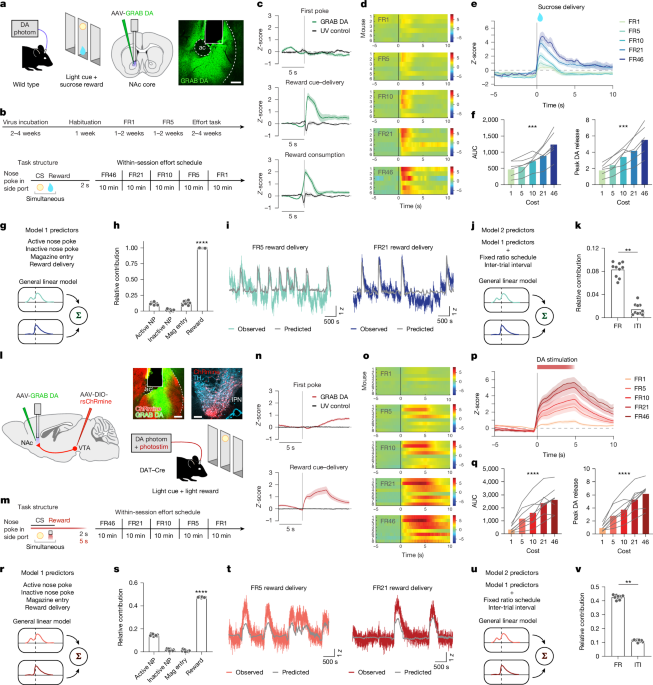
"Reward delivery evokes a burst of dopamine (DA) release in the nucleus accumbens (NAc), helping to promote reward-seeking behaviours15,16. The amplitude of this DA burst integrates multiple attributes of the reward, including both the size of the reward and how much effort went into it. Although DA release is largely driven by the firing of DA neurons in the midbrain, studies have proposed a key role for local modulation of DA axon terminals in the striatum as well20,21,22,23."
"Recently, we have found that DA release scales with preceding effort even if DA axon terminals in the NAc are stimulated directly via optogenetics17. When mice work for an identical optogenetic stimulation, more effort leads to more DA release. We reasoned that this variability in DA release might result from local modulation of DA axon terminals, a phenomenon that has been studied at length in vitro20,21,22,23 but has proven more difficult to isolate in vivo."
"Of the many modulators with potential to calibrate DA release, acetylcholine (ACh) consistently emerges as a potent effector, although the nature of this interaction has been contested6,7,8,9,10,11,12,13,14,27. In particular, there is ongoing debate over whether cholinergic interneurons in the striatum, which are capable of eliciting axonal DA release independent of DA cell body activity6,7,8,9,10,11, actually do so in any behavioural context."
Reward-evoked dopamine release increases with higher preceding effort even when dopamine axon terminals are directly stimulated. Dopamine burst amplitudes integrate both reward size and expended effort. Midbrain dopamine neuron firing largely drives release, but local modulation of dopamine axon terminals in the striatum can adjust release independently. Acetylcholine consistently functions as a potent effector on dopamine release, though the precise nature of the interaction is contested. Debate continues over whether striatal cholinergic interneurons elicit axonal dopamine release independent of dopamine cell body activity during behaviour. A behavioural task varying FR1 and FR5 schedules manipulates effort for identical sucrose rewards.
Read at Nature
Unable to calculate read time
Collection
[
|
...
]