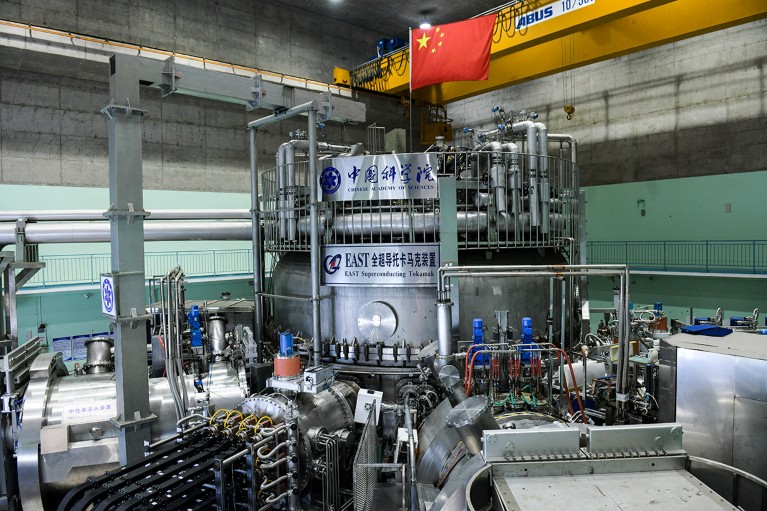
"Researchers working on China's 'artificial sun' have reported breaking a long-accepted threshold that has limited the operation of nuclear-fusion reactors for decades. China's Experimental Advanced Superconducting Tokamak (EAST) is a nuclear-fusion research reactor in Hefei. Researchers hope that it will one day produce clean, virtually limitless energy by replicating the fusion processes that power the Sun. In fusion reactors, light-weight atoms are compressed under extreme pressure and heat to form heavier atoms."
"This process releases energy, but it must be carefully optimized so that the reactor produces more energy than it consumes. One of the most promising reactor designs, the tokamak, confines plasma inside a doughnut-shaped chamber using magnetic fields. The plasma is then heated. To sustain fusion reactions, the plasma must reach an extremely high density - meaning many particles must be packed into a small volume."
"But, researchers thought that plasma could not exceed a certain density without becoming unstable. This upper limit - known as the Greenwald limit - has been a major obstacle for fusion research, particularly for tokamak-type devices. In a paper published on 1 January in Science Advances, scientists working on China's EAST device reported pushing plasma densities beyond this limit, achieving densities 30% to 65% higher than those normally reached by EAST."
China's EAST tokamak demonstrated plasma densities 30% to 65% higher than its previous norms by exceeding the long-accepted Greenwald limit. The tokamak confines plasma in a doughnut-shaped chamber using magnetic fields and heats it to induce fusion, which requires very high particle densities. The Greenwald limit had constrained tokamak performance by linking high density to instability. The experiments established stable conditions between plasma and the reactor wall, reduced impurities, and allowed higher density operation. The result indicates that density ceilings in tokamaks can be raised, offering a pathway to improved fusion performance and warranting tests on other devices.
Read at Nature
Unable to calculate read time
Collection
[
|
...
]