"Last month, Chinese astronauts on board the country's Tiangong space station discovered cracks in the window of their return vehicle, the Shenzhou-20, which officials suspected were the result of a space debris strike. The Shenzhou-20 spacecraft was deemed not safe enough to return its crew after the cracks were found, prompting an orbital game of musical chairs as the China Manned Space Agency (CMSA) launched an emergency uncrewed replacement spacecraft, Shenzhou-22, to the station."
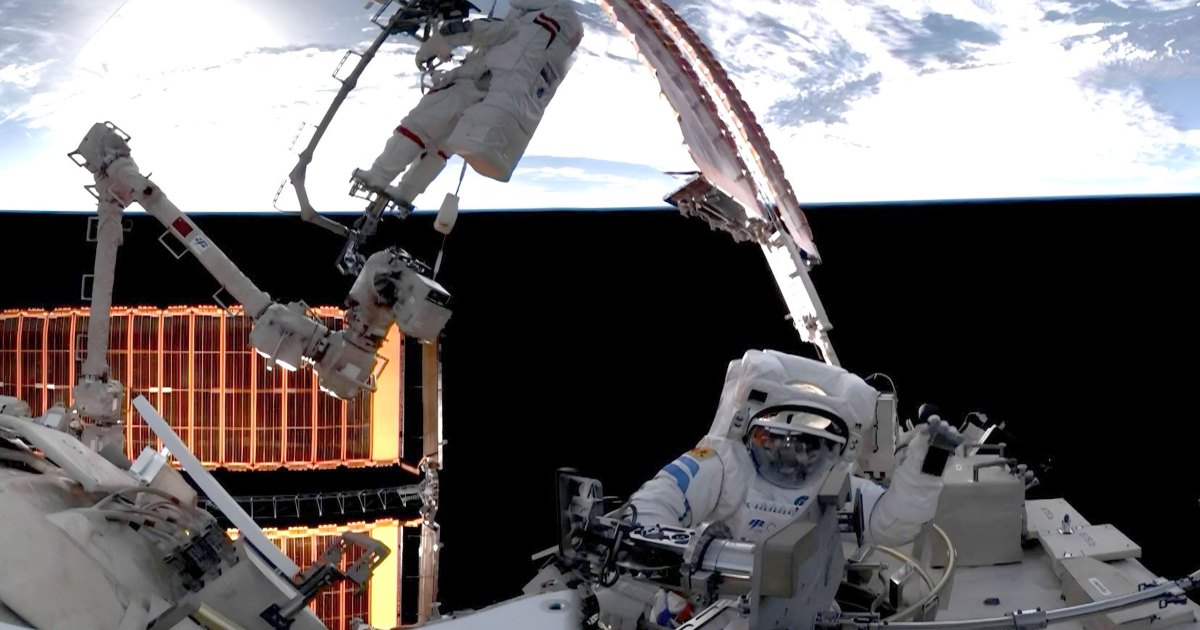
"The goal was to provide the Shenzhou-21 crew, who arrived at the station right as the cracks were discovered, with an emergency escape vehicle, since the Shenzhou-21 spacecraft they'd flown up in had to step in to bring the Shenzhou-20 crew back to Earth, leaving their replacements temporarily stranded aboard the station. Now, two of the Shenzhou-21 crew clambered outside of the space station late Monday to inspect the damage to the window of the Shenzhou-20 capsule, as SpaceNews reports."
"Mission commander Zhang Lu and fellow crewmember Wu Fei, who became the youngest Chinese astronaut to perform an EVA during the walk at age 32, according to the CMSA, spent a total of eight hours outside of the station, taking the time to photograph and assess the damage. While we await the results of their investigation, it's an impressive turnaround time."
Chinese astronauts aboard the Tiangong space station discovered cracks in the Shenzhou-20 return vehicle window, suspected to result from a space debris strike. The spacecraft was deemed unsafe for crew return, triggering an emergency response that included launching an uncrewed Shenzhou-22 replacement. Shenzhou-21's vehicle had to return the Shenzhou-20 crew, leaving the Shenzhou-21 crew temporarily without their intended escape vehicle. Two Shenzhou-21 crewmembers conducted an eight-hour EVA to photograph and assess the damage, with one crewmember becoming the youngest Chinese astronaut to perform an EVA at age 32. The sequence demonstrates rapid mission responsiveness and highlights orbital vulnerability to space debris despite frequent launches.
Read at Futurism
Unable to calculate read time
Collection
[
|
...
]