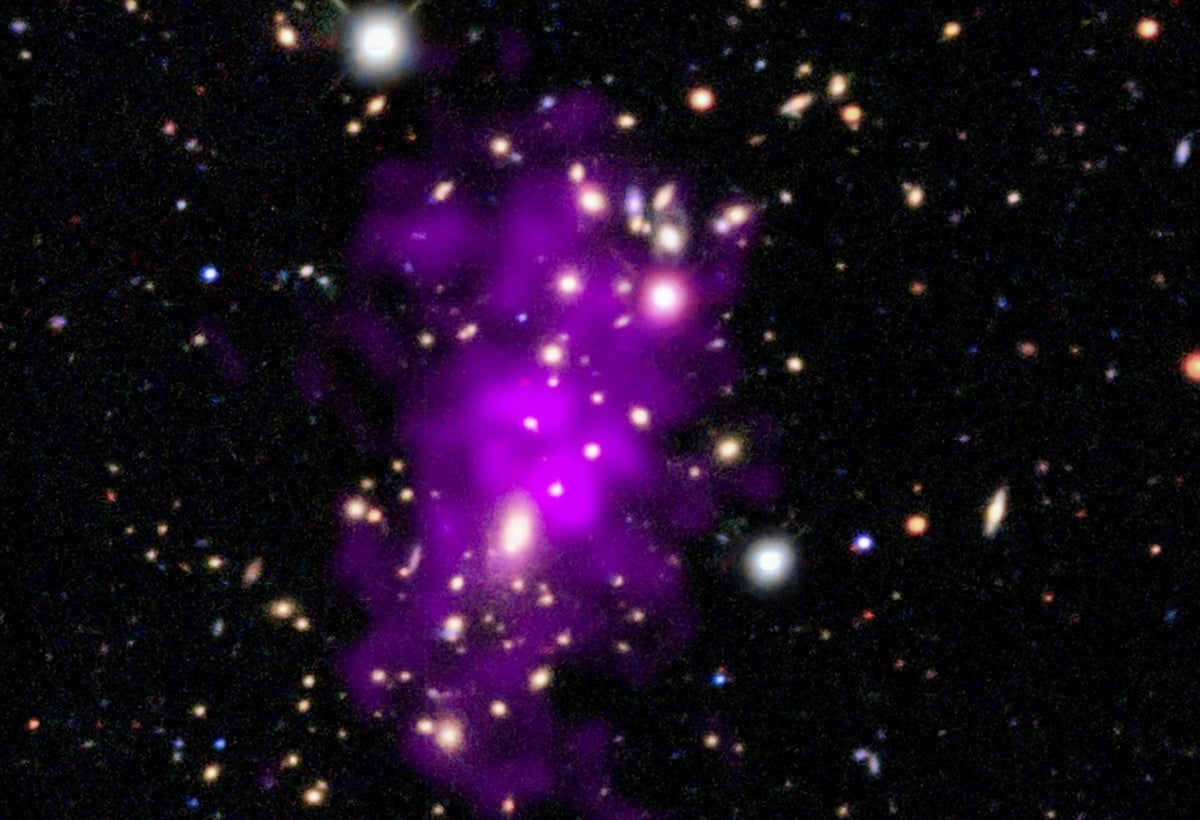
The Champagne Cluster (RM J130558.9+263048.4) was discovered on December 31, 2020 and appears in a composite image combining Chandra X-ray observations and ground-based optical data. Chandra reveals superheated, multimillion-degree gas as purple bubbles while optical telescopes provide the starry background. Initial observations misidentified the object as a single cluster; later data show two interacting clusters that together contain more than 100 galaxies and vast amounts of hot gas that outweigh the galaxies. Scientists propose two hypotheses: an initial collision over two billion years ago leading to a bound orbital encounter, or a more recent collision about 400 million years ago with the clusters separating. Both scenarios involve an almost head-on impact.
"Raise a toast to another orbit around the sun with a new NASA image of sparkling galaxy clusters fittingly dubbed the Champagne Cluster. The object was first discovered on December 31, 2020. But the new image combines data from NASA's Chandra X-ray Observatorywhich sees the superheated gas of the merging clusters as purple bubblesand a collection of ground-based optical telescopes that contribute the starry background."
"When the Champagne Cluster was first observed, astronomers thought the celestial objectformally named RM J130558.9+263048.4was a single galaxy cluster, but subsequent observations have revealed that it is in fact two clusters interacting. All told, the merger involves more than 100 galaxiesplus enough multimillion-degree gas to outweigh them all. Scientists have two theories to explain the Champagne Cluster's distinct appearance. Both of them were outlined in research published earlier this year in the Astrophysical Journal."
"The first hypothesis is that the two clusters first collided more than two billion years ago, blowing past each other before being trapped in a gravitational dance that will eventually see them smash together again. According to the second theory, the clusters' collision happened just 400 million years ago, and the two objects are now zipping away from each other. Either way, the researchers say, the clusters crashed into each other practically head-on."
Read at www.scientificamerican.com
Unable to calculate read time
Collection
[
|
...
]