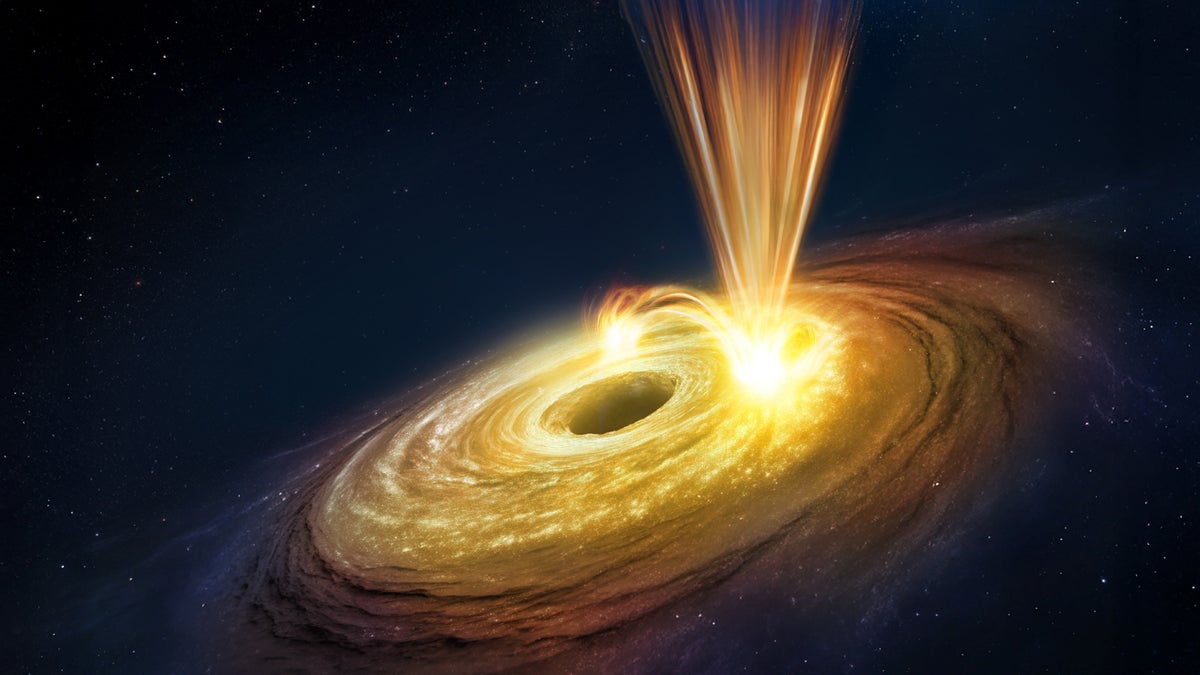
A supermassive black hole at the center of spiral galaxy NGC 3783 produced a bright X-ray flare that faded within hours and then drove powerful winds. The black hole has a mass of about 30 million suns and powers an active galactic nucleus. Post-flare winds flung material into space at roughly 130 million miles per hour, about one-fifth the speed of light. That outflow velocity far exceeds typical solar coronal mass ejections, which travel near three million mph. Observations came from ESA's XMM-Newton and the X-Ray Imaging and Spectroscopy Mission (a collaboration of ESA, NASA and JAXA). Tangled magnetic fields may have untwisted to launch the winds, and understanding such jets and winds informs galaxy formation processes.
"Supermassive black holes are the monsters of the universe, so it is perhaps only fitting that astronomers discovered one of these behemoths unleashing a bright x-ray flare that one of the researchers, astronomer Matteo Guainazzi, described as almost too big to imagine in a European Space Agency (ESA) press release. Within hours of erupting, the blast faded, and the black hole began to whip up winds more powerful than anything we can imagine on Earth"
"flinging material into space at about 130 million miles per houra fifth of the speed of light. For comparison, plasma ejected during a coronal mass ejection from the sun typically travels at a mere three million mph. To study the black hole, astronomers used two x-ray space telescopes: the ESA's XMM-Newton and the X-Ray Imaging and Spectroscopy Mission, which is a collaboration between the ESA, NASA and the Japan Aerospace Exploration Agency."
Read at www.scientificamerican.com
Unable to calculate read time
Collection
[
|
...
]