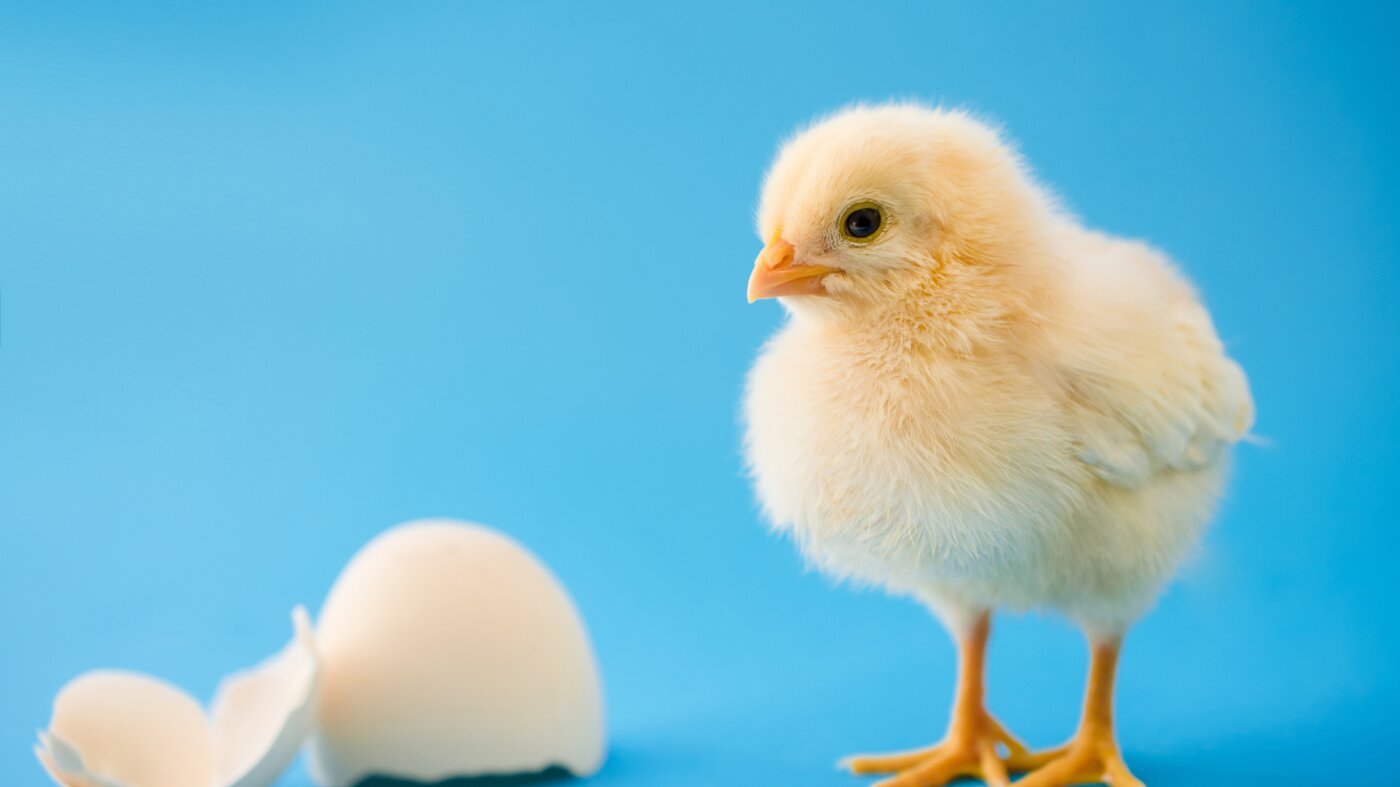
"When people are shown a spiky shape next to a rounded one and asked which shape is called "kiki" and which one is "bouba," people from all kinds of cultures overwhelmingly associate "bouba" with the blob-like shape and "kiki" with the more jagged, pointy one. And it turns out that baby chickens do the exact same thing. A set of experiments with chicks, described in the journal Science, suggests that these birds, like humans, associate the nonsense word "bouba" with roundness and "kiki" with spikiness."
"a group of researchers at the University of Padova in Italy recently decided to take a completely different approach to look for it in animals: they tested very young chickens. "With chicks, we had the chance to test animals at the very, very first stage of life," says researcher Maria Loconsole, who did the experiments with colleagues Silvia Benavides-Varela and Lucia Regolin. Being able to test the chicks so young would mean that any observed associations between sounds and shapes would be innate,"
People across cultures associate the nonsense word "bouba" with rounded shapes and "kiki" with jagged shapes. Four-month-old human infants show the same associations. Very young domestic chicks also associate "bouba" with roundness and "kiki" with spikiness, based on experiments. Great apes tested previously did not show the bouba-kiki effect. Testing chicks at the earliest stage of life allows distinguishing innate predispositions from learned behavior. The presence of similar sound-shape correspondences in chicks and humans suggests a biological basis that could have contributed to the development of spoken symbolic systems.
Read at www.npr.org
Unable to calculate read time
Collection
[
|
...
]