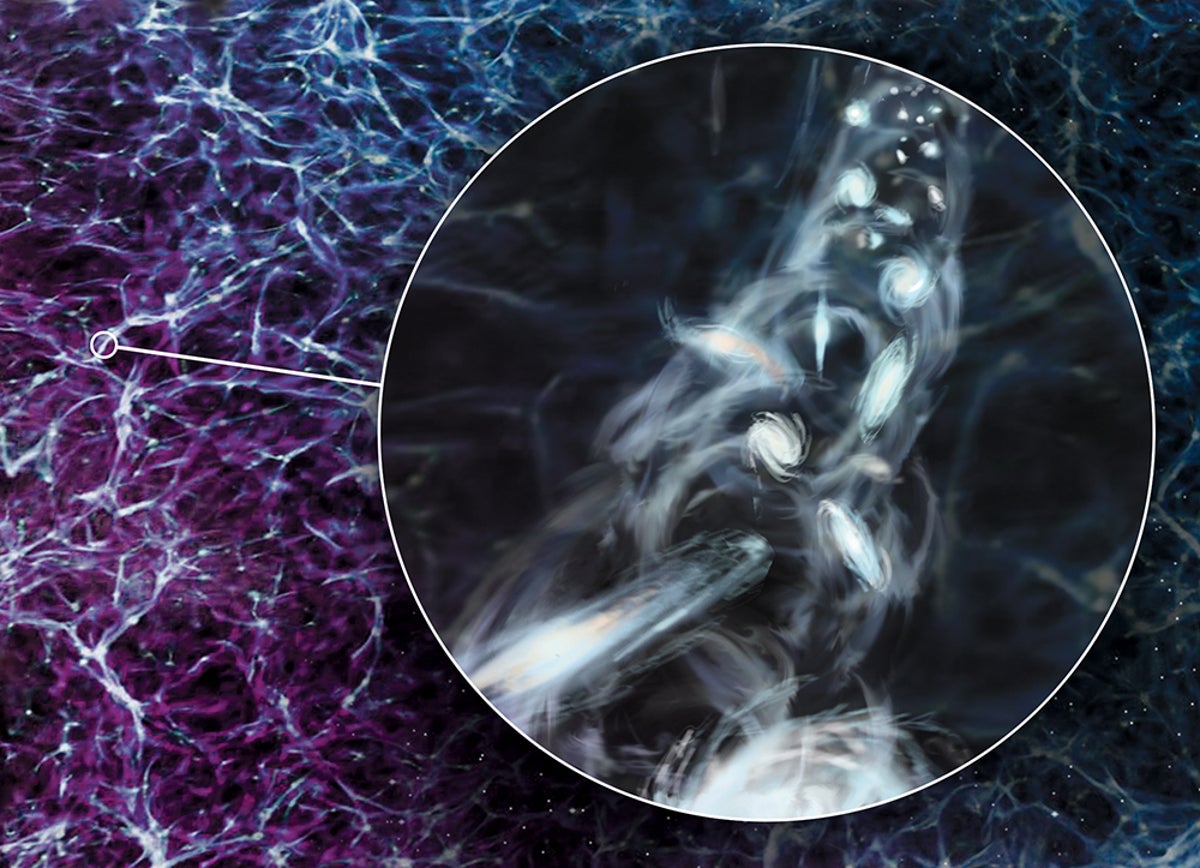
"The first time that University of Oxford astronomer Lyla Jung saw the cosmic configuration on her monitor, she almost didn't believe it was real. But it wasand Jung and her colleagues went on to identify one of the largest rotating structures ever found in space: a chain of galaxies embedded in a spinning cosmic filament 400 million light-years from Earth. The finding, published in Monthly Notices of the Royal Astronomical Society, may give astronomers new insights into galaxies' formation, evolution and diversity, Jung says."
"Galaxies are not positioned either randomly or uniformly in the universe; instead they are connected in structures called filaments that link them, together with dark matter, across space. Along with voidsempty spaces that contain very little matterand groups of hundreds of thousands of galaxies known as clusters, filaments form what astronomers call the cosmic web. These filaments are the main channels through which matter flows, feeding galaxies and clusters as structures expand."
"By studying filaments, we gain insight into how large-scale structure forms and how galaxies acquire their spins, says astrophysicist Peng Wang of the Shanghai Astronomical Observatory, who was not involved in the new study. In 2021 Wang and his colleagues reported that based on calculations and satellite imagery, several filaments seemed to be rotating. The new study takes a closer look at one of these structures."
An observational team identified a chain of 14 hydrogen-rich galaxies arranged in a thin, 5.5-million-light-year structure embedded within a spinning cosmic filament about 400 million light‑years from Earth. The structure was detected using MeerKAT radio-telescope mapping of cold hydrogen gas in nearby galaxies. Filaments, together with voids and clusters, compose the cosmic web and act as channels that funnel matter into galaxies and clusters as structures grow. Rotating filaments can influence how galaxies acquire their spins and evolve. Previous calculations and satellite imagery indicated several filaments might rotate; the new observation examines one such rotating filament in detail.
Read at www.scientificamerican.com
Unable to calculate read time
Collection
[
|
...
]