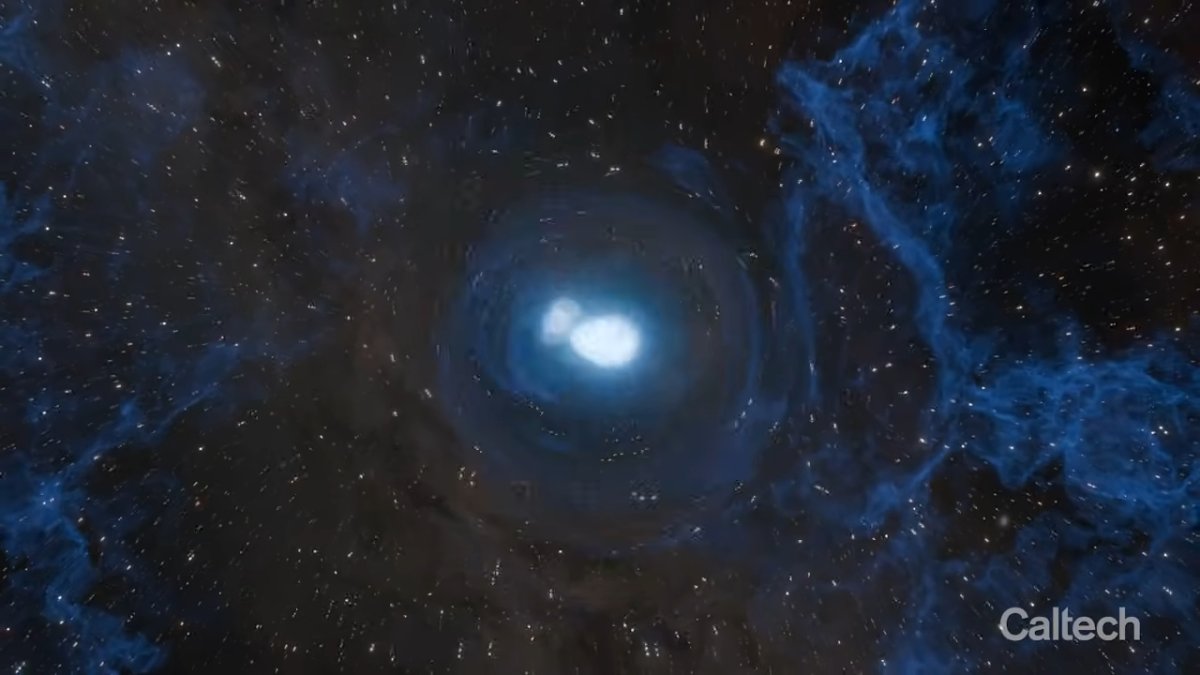
"A team of astronomers believe they've witnessed a star split in half before merging back together again, triggering an ungodly double explosion that's sending seismic ripples through both the scientific community and spacetime itself. The incredible event, designated AT2025ulz, may represent an entirely new class of astrophysical phenomena: a "superkilonova," meaning an even more spectacular iteration on the already elusive kilonova. Extraordinary claims require extraordinary evidence, and the findings, described in a study published in The Astrophysical Journal Letters, aren't hard proof - but they undoubtedly point to something strange afoot."
"Massive stars typically die in an explosion called a supernova, seeding the cosmos with heavy metals and producing a distinct signature. Sometimes, the blasts leave behind an ultra-dense core called a neutron star, which contains more mass than the Sun in a sphere roughly the size of a city. These, too, can go out with a bang. Neutron stars can be found in binary pairs, and when their incredible gravity draws them together, their collision causes an equally catastrophic explosion called a kilonova."
AT2025ulz, located about 1.3 billion light years away, showed extraordinary behavior suggesting a star split and then merged, producing a double explosion. The event may represent a new class called a "superkilonova," an amplified form of a kilonova produced by neutron-star mergers. On August 18, 2025, LIGO and Virgo detected powerful gravitational waves consistent with a merger, while telescopes recorded mixed electromagnetic signatures that sometimes resembled a supernova. Kilonovae are far rarer than supernovae and are produced by colliding neutron stars. Current data are intriguing but not yet conclusive.
Read at Futurism
Unable to calculate read time
Collection
[
|
...
]