"Although there are four known fundamental forces to the Universe, there's only one that matters on the largest cosmic scales of all: gravitation. The other three fundamental forces: the strong nuclear force, which holds protons and neutrons together, the weak nuclear force, responsible for radioactive decays and any "species change" among quarks and leptons, and the electromagnetic force, which causes neutral atoms to form, are all largely irrelevant on cosmic scales. The reason why is simple: the other forces, when you gather large sets of particles together, all balance out at large distances. Matter, under those three forces, appears "neutral" at large scales, and no net force exists."
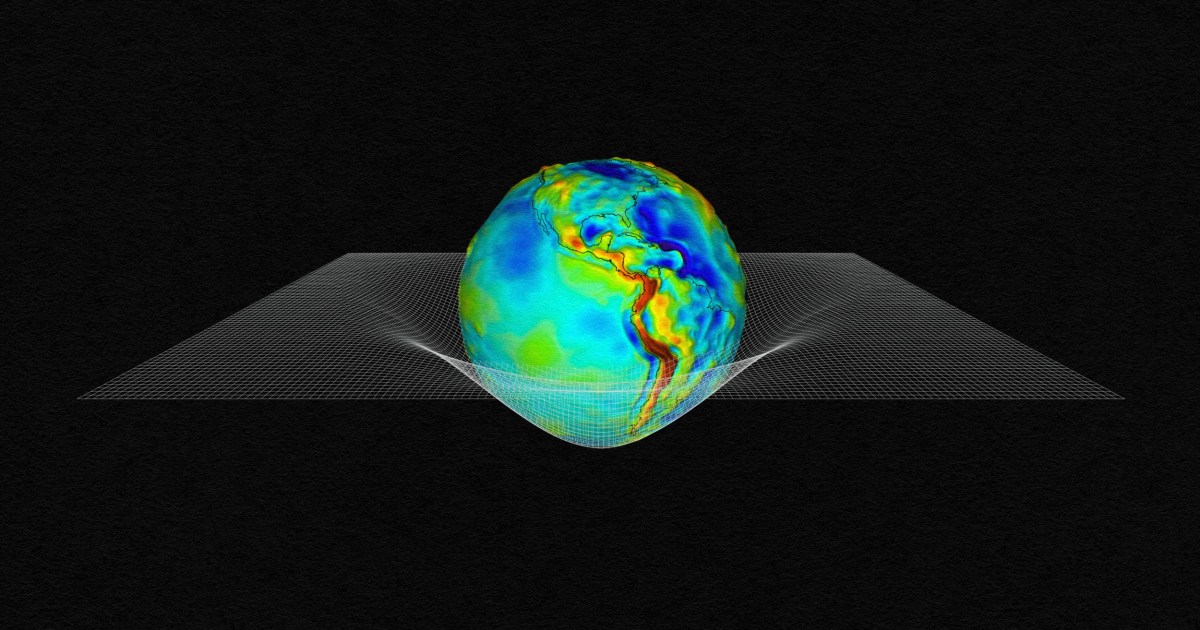
"The common model used to explain spacetime to laymen like me is the bowling ball on a bedsheet. The weight of the ball deforms the flat sheet and draws in smaller objects nearby. But it seems logical that the bedsheet could be deformed in the other direction (upward, to continue with the bedsheet analogy) by a very similar object, pushing objects away from the point of deformation. However, we never observe this occurring. Why? Why does spacetime only bend in one direction (that of gravity)?"
On the largest cosmic scales, electromagnetic, strong, and weak forces cancel out because large collections of particles become neutral under those interactions, producing no net long-range effect. Gravity is unique because its source—mass and energy—is always positive, so gravitational attraction between masses never cancels and can accumulate over vast distances. That cumulative, always-attractive nature makes gravity the dominant force shaping large-scale structure. The bowling-ball-on-a-bedsheet analogy illustrates curvature of space by mass, prompting the question of why space never appears to curve oppositely to produce repulsive gravitational effects.
Read at Big Think
Unable to calculate read time
Collection
[
|
...
]