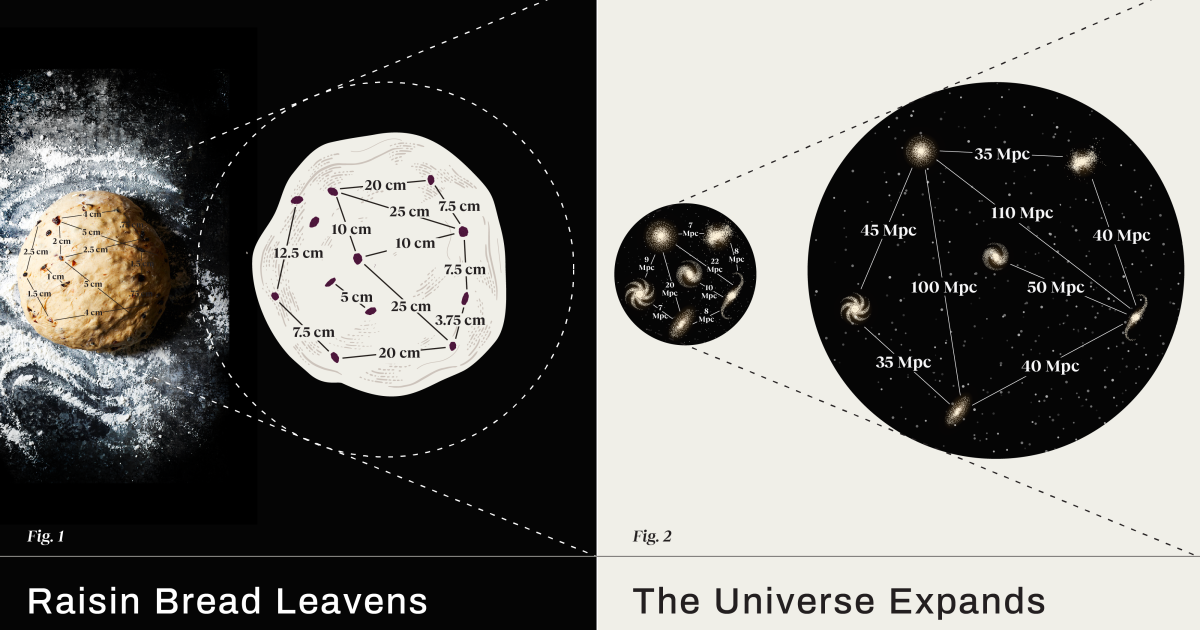
"Within the context of General Relativity, there are a number of possible explanations for an observed redshift: it could be due to the relative motion of the source and the observer, it could be due to a different in the curvature of space between the source and the observer, or it could be due to the fabric of space itself stretching and expanding as light travels through it."
"Yet, if it were the effects of gravitational masses (like galaxies) tugging on other masses (like other galaxies) that dominated the Universe, you'd expect that there would be equal numbers of galaxies that are redshifted as compared to blueshifted, and yet there are far fewer blueshifted galaxies, and almost none at all that are very far away from us. Why is that? What do those observations teach us, and are we interpreting them correctly?"
Nearly every galaxy beyond the Milky Way exhibits light shifted toward longer, redder wavelengths. General Relativity allows three broad causes of observed redshift: relative motion between source and observer (Doppler), differing gravitational potentials altering light's frequency, and expansion of space stretching light during its journey. If gravity from massive objects dominated cosmic motions, redshifts and blueshifts would appear in roughly equal numbers as galaxies tugged on one another. Observations instead show far more redshifted galaxies and almost no blueshifted objects at large distances, implying a dominant cosmological expansion producing a coherent recessional flow.
Read at Big Think
Unable to calculate read time
Collection
[
|
...
]