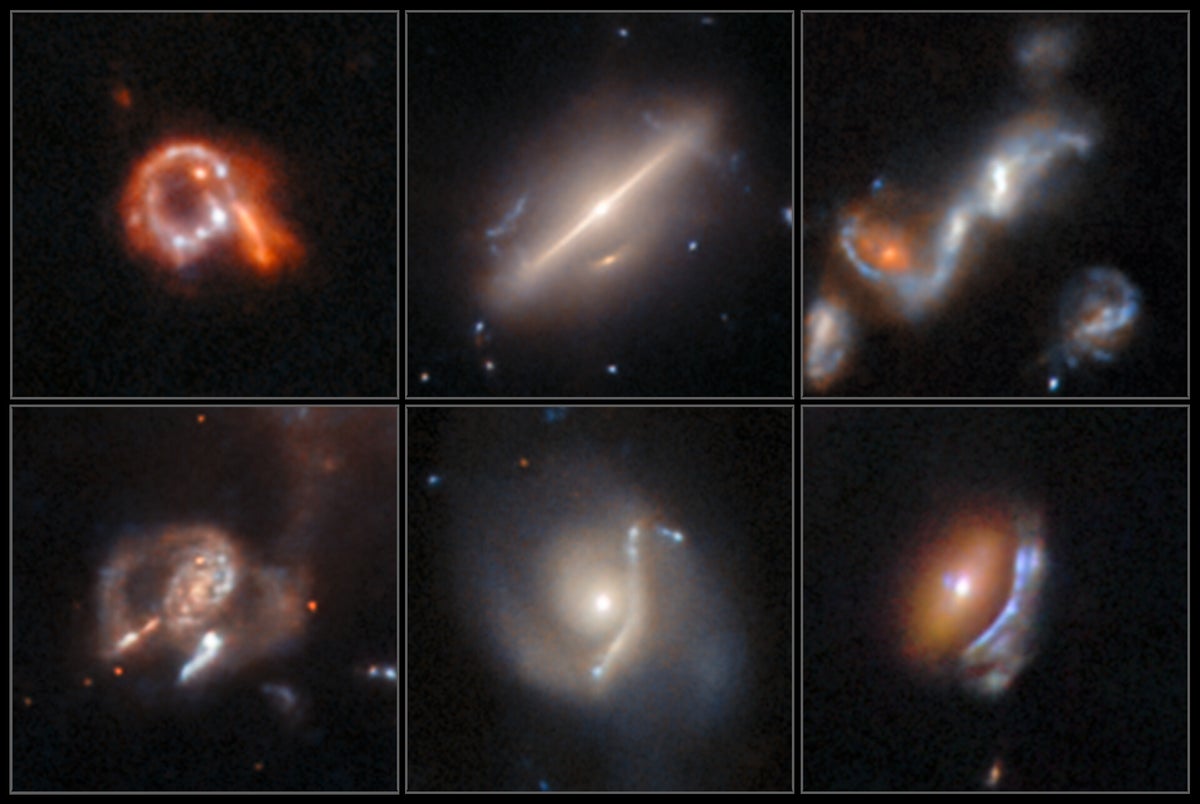
Researchers at the European Space Agency developed an AI tool that processed nearly 100 million image cutouts from the Hubble Legacy Archive, covering data up to 35 years old. The AI completed the search in about two and a half days, a task that would take humans exponentially longer. The search flagged more than 1,300 anomalous objects, including galaxy mergers, jellyfish galaxies with trailing gas, collisional ring galaxies, and numerous possible gravitational lenses. Approximately 800 of the detected anomalies had not been previously described. The discoveries include dozens of other oddball objects that defy easy classification.
"The universe is so vast, and the difficulty of discovering all that there is out in the cosmos is so great, that one might as well count all the grains of sand in the Sahara. But now, with the help of artificial intelligence, astronomers have revealed more than 800 previously unknown cosmic anomalies hidden in archival data from the Hubble Space Telescope."
"The hunt turned up more than 1,300 anomalous objects, including galaxy mergers, jellyfish galaxies (so named for their trailing tentacles of gas) and other unusual features. Among these were scores of possible gravitational lensesspots where a massive object, such as a galaxy, bends the light of a given source, such as another galaxyas well as dozens of other oddball objects that defied easy explanation."
Read at www.scientificamerican.com
Unable to calculate read time
Collection
[
|
...
]