"V1298 Tau is a young (10-30 Myr), approximately solar-mass star (1.10 ± 0.05 M⊙ ) in the Taurus star-forming region2,4,5,6,7,8. Observations by NASA's Kepler space telescope in its extended K2 mission9 revealed transits of the star by four different planets, each larger than Neptune2,3. The V1298 Tau planets occupy a sparsely populated region of the observed exoplanet period versus radius plane. As a young system of large planets, it provides a crucial snapshot of planetary architecture"
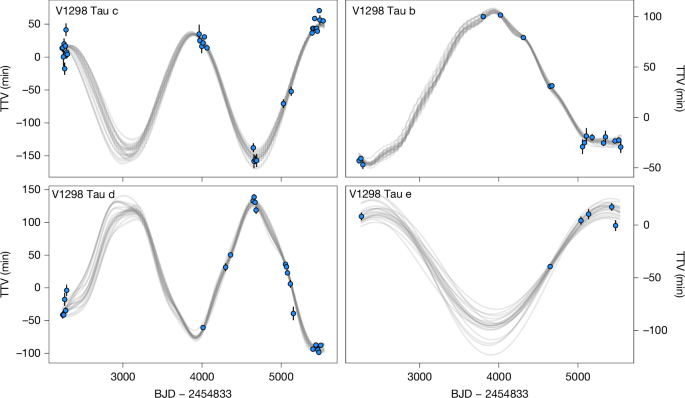
"Between 2019 and 2024, we observed 43 other transits of all four planets using both space- and ground-based telescopes. This campaign successfully recovered the previously lost outermost planet, V1298 Tau e, and resolved a long-standing period ambiguity10 ( Methods). We performed homogeneous and self-consistent modelling of all transit data from 2015 to 2024. After determining the transit shape parameters, we fit the midpoint of each transit individually ( Methods). The transit-timing variations (TTVs) are shown in Fig. 1."
V1298 Tau is a young (10–30 Myr), roughly solar-mass star in the Taurus star-forming region that hosts four transiting planets larger than Neptune. The planets occupy a sparsely populated region of the period–radius plane and represent an early snapshot of planetary architectures. Between 2019 and 2024, 43 additional transits were observed, recovering the outermost planet V1298 Tau e and resolving a period ambiguity. Homogeneous, self-consistent modeling of transit shapes from 2015–2024 was performed and individual transit midpoints were measured. All four planets show significant transit-timing variations of roughly 50–100 minutes, with c–d and b–e pairs showing anticorrelated TTVs, indicating dominant pairwise gravitational interactions.
Read at Nature
Unable to calculate read time
Collection
[
|
...
]