"All experiments were conducted in a 6-8 multi-anvil apparatus with 32 mm edge length WC cubes featuring 11 mm truncations and 18 mm edge octahedra, calibrated against the transitions of quartz-coesite, garnet-perovskite in CaGeO 3, and coesite-stishovite. The assembly consists of a Cr-doped MgO-octahedron, a zirconia sleeve, a stepped graphite furnace, inner MgO parts and a PtRh B-type thermocouple. Full details, including pressure calibration, are provided in ref. ."
"Based on previous experience with similar temperatures and melt compositions, equilibrium is typically achieved within 1-2 h. Consequently, our run times ranged from 2 h to 8 h, increasing with decreasing temperature. The starting mixtures were loaded into Re capsules folded from foil, placing a thin graphite layer at the bottom and top. These were then inserted into a Pt capsule, which was welded shut to contain the volatiles. The graphite-CO 2melt pair yields the appropriate oxygen fugacity for redox melting."
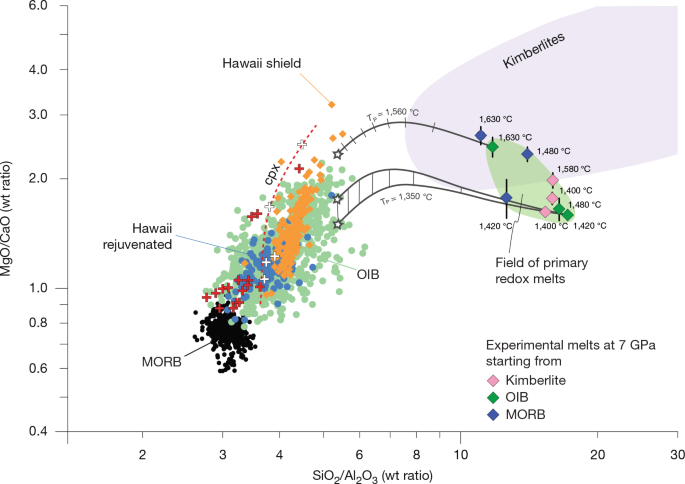
Experiments used a 6-8 multi-anvil apparatus with calibrated WC cubes and an assembly including a Cr-doped MgO octahedron, zirconia sleeve, stepped graphite furnace, inner MgO, and a PtRh B-type thermocouple. Equilibrium is typically reached within 1–2 hours, so run durations ranged from 2 to 8 hours, increasing at lower temperatures. Starting mixtures were loaded into folded Re capsules with graphite layers and enclosed in welded Pt capsules to retain volatiles. Experiments equilibrated erupted surface melts with a lherzolite mantle at 7 GPa and 1,420–1,630°C (mantle potential temperatures 1,350–1,560°C). Starting compositions included an average primitive OIB basanite and a primitive MORB average, with OIB volatile contents of ~5.4 wt% CO2 and 1.9 wt% H2O and MORB values of up to 1.0 wt% CO2 and 0.5 wt% H2O.
Read at Nature
Unable to calculate read time
Collection
[
|
...
]