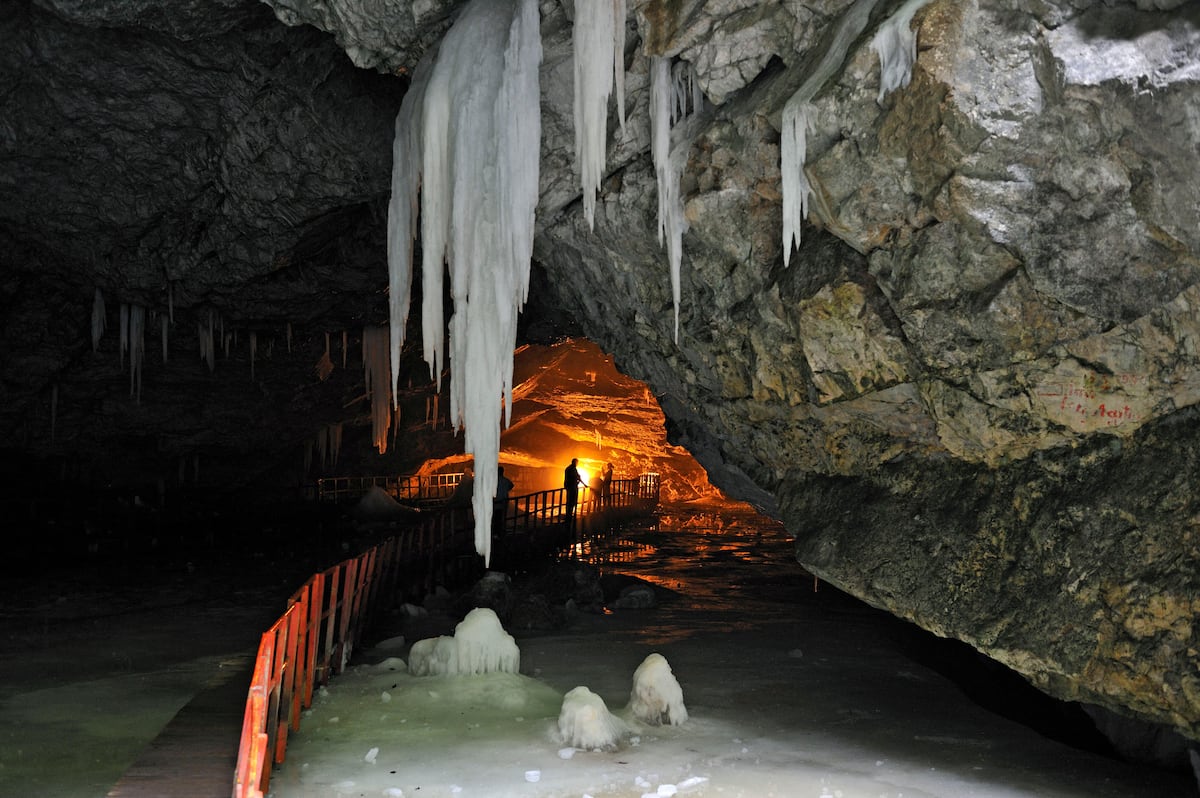
"It has been named Psychrobacter SC65A.3 and was found buried under meters of ice in a cave in Romania. It had been entombed for some 5,000 years and, despite this, appears to be resistant to a dozen modern antibiotics. Its discoverers have also found that it inhibits the growth of other bacteria, including some of the most difficult-to-treat pathogens. The research, published in the scientific journal Frontiers in Microbiology,"
"It houses one of the world's largest underground glaciers, with an ice block of approximately 75,000 cubic meters. There, the stalactites and stalagmites are a strange mixture of ice and calcite. From one of its chambers, researchers extracted a 25-meter-long ice core, dating back some 13,000 years. At a depth of 16.5 meters corresponding to 5,335 years ago according to carbon dating they found an entire bacterial ecosystem, with microorganisms likely active, not dormant."
The bacterium, named Psychrobacter SC65A.3, was recovered from meters of ice in a Romanian cave and had been entombed for about 5,000 years. The strain shows resistance to roughly a dozen modern antibiotics while inhibiting growth of other bacteria, including some difficult-to-treat pathogens. Genetic analysis indicates limited DNA identity with closest Psychrobacter relatives, suggesting a unique lineage with specific adaptations. The Scarisoara Cave contains one of the world's largest underground glaciers; a 25-meter ice core revealed a bacterial ecosystem at 16.5 meters depth corresponding to about 5,335 years ago, with microorganisms likely active rather than dormant.
Read at english.elpais.com
Unable to calculate read time
Collection
[
|
...
]