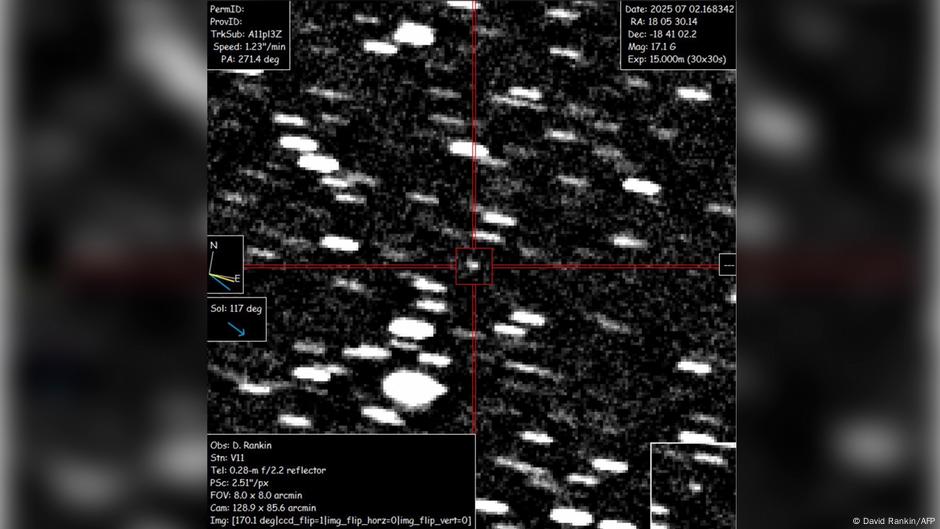
"In the early morning hours of Friday, December 19, you could spot the visitor from another solar system in the sky with a serious telescope, that is. Comet 3I/ATLAS flew by Earth at a distance of 270 million kilometers (168 million miles). That was its closest approach to our planet. From here, the comet will continue its journey and pass by Jupiter in early 2026 before crossing the orbits of Saturn, Uranus and Neptune by 2028 and then leaving our solar system."
"Beyond the fact that this is the third known interstellar object to have entered our solar system, "we don't know very much," said Larry Denneau, co-principle investigator at ATLAS, a telescope in Chile that spotted 3I/ATLAS on July 1, 2025. It's not exactly reassuring when scientists say "we don't know," but at least it's honest. Astronomers do know that 3I/ATLAS is a comet that was about 670 million kilometers (416 million miles) away from the sun when it was first spotted."
"The comet is thought to be about 20 kilometers (12.4 miles) wide and traveling at about 60 kilometers per second (an impressive 134,000 miles per hour). This data allowed astronomers at the Asteroid Terrestrial-impact Last Alert System in Chile to spot it. When they saw the object on an unusual trajectory, they immediately began to track and measure it. Then, other astronomers based at telescopes in Hawaii and Australia, began monitoring the object's flight progress and confirmed it as an interstellar comet."
Comet 3I/ATLAS is the third known interstellar object to enter the solar system and reached its closest approach to Earth at 270 million kilometers on December 19. The object was first spotted on July 1, 2025 at about 670 million kilometers from the sun by ATLAS in Chile and was subsequently tracked by telescopes in Hawaii and Australia. Estimated dimensions are roughly 20 kilometers across and a speed near 60 kilometers per second. The comet poses no danger to Earth and will pass Jupiter in early 2026, cross the orbits of Saturn, Uranus and Neptune by 2028, then depart the heliosphere and the solar system.
Read at www.dw.com
Unable to calculate read time
Collection
[
|
...
]