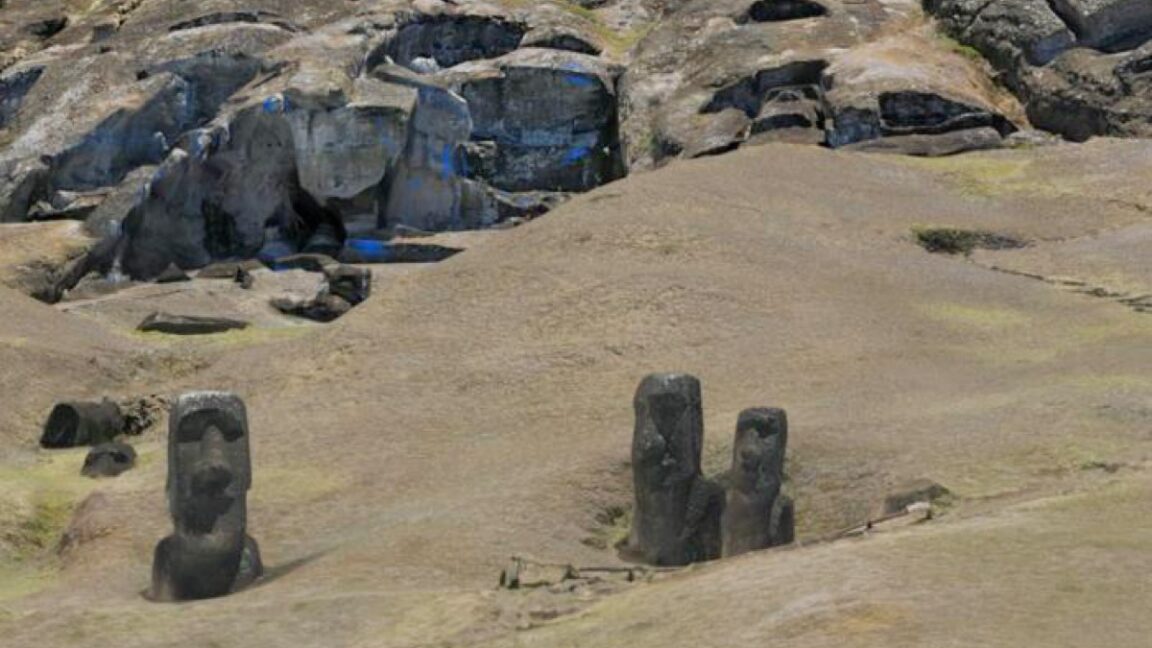
""You can see things that you couldn't actually see on the ground. You can see tops and sides and all kinds of areas that just would never be able to walk to," said co-author Carl Lipo of Binghamton University. "We can say, 'Here, go look at it.' If you want to see the different kinds of carving, fly around and see stuff there. We're documenting something that really has needed to be documented, but in a way that's really comprehensive and shareable.""
"Lipo's latest field trials showed that the "walking" method can be accomplished with far fewer workers: 18 people, four on each lateral rope and 10 on a rear rope, to achieve the side-to-side walking motion. They were efficient enough in coordinating their efforts to move the statue forward 100 meters in just 40 minutes. That's because the method operates on basic pendulum dynamics, which minimizes friction between the base and the gr"
A high-resolution interactive 3D model of the Rano Raraku quarry documents quarry surfaces, carving types, and otherwise inaccessible areas around moai. The model reveals that numerous independent groups, likely family clans, carried out moai carving rather than a centralized management system. The model provides comprehensive, shareable views of tops, sides, and carvings to support targeted field inspection. Field experiments reproduced the vertical "walking" transport, demonstrating that 18 people using lateral and rear ropes can move a statue 100 meters in 40 minutes by exploiting pendulum dynamics to minimize base friction. These results lower required population estimates and clarify carving and transport processes.
Read at Ars Technica
Unable to calculate read time
Collection
[
|
...
]